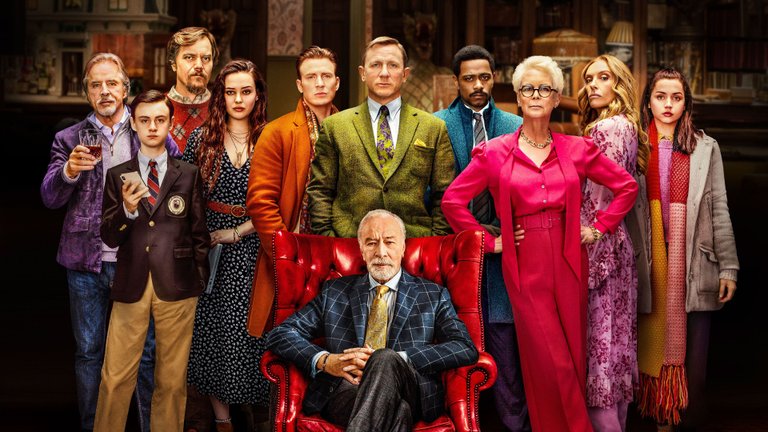
To understand the cultural positioning of Rian Johnson’s 2019 film Knives Out, one must first acknowledge the director’s own contentious place in contemporary popular cinema. By 2019, Johnson had become the focus of a visceral, often toxic dislike among a significant segment of Star Wars fandom, owing to what they perceived as an over-creative and disrespectful mishandling of 2017’s Star Wars: The Last Jedi. For many, that film is interpreted as the blow from which the franchise has never truly recovered, a catalyst for its subsequent creative and commercial stumbles. Yet, for all the fans’ vitriol, Johnson maintained—and indeed, cultivated—a reputation as a distinctive author in his own right, established by the clever neo-noir Brick and later reinforced by the time-travel thriller Looper. Knives Out arrived at a right moment, allowing Johnson to step away from galactic opera and return to grounded, genre-driven storytelling. The film’s remarkable success is now seen as the start of one of the rare, truly original film series in our era of endless sequels and reboots.
The plot unfolds primarily within the cavernous Gothic Revival mansion of the eponymous 85-year-old crime fiction magnate Harlan Thrombey (Christopher Plummer). Following a family gathering for his birthday, Harlan is discovered with his throat slit, the initial investigation leaning towards a straightforward suicide. The local police, perhaps out of their depth amidst such opulence, invite the famed private investigator Benoit Blanc (Daniel Craig) to assist. Unbeknownst to them, Blanc has been anonymously hired, a detail that immediately signals foul play. The Thrombey clan, a gallery of dysfunction and entitlement, provides a rich seam of suspicion. Yet, the initial focus settles on Harlan’s devoted nurse, Marta Cabrera (Ana de Armas). Johnson’s first major narrative feint is revealed through a mid-film flashback: Harlan’s death was the result of a tragic pharmacological accident. In a grand, novelistic gesture, Harlan improvises an elaborate deception and takes his own life to shield Marta from blame. This apparent resolution is spectacularly upended by the reading of Harlan’s will, which bequeaths his entire fortune to Marta, disinheriting his bloodline. The film then pivots into a second act of escalating peril, as Marta becomes entangled in a web of apparent blackmail, arson, and murder, forcing Blanc to deduce that the initial “accident” was perhaps not so accidental after all.
Johnson is no stranger to the crime genre. His feature debut, 2005’s Brick, was a slightly bizarre and memorable modern-day homage to hardboiled film noir, transposing Dashiell Hammett-esque dialogue to a Californian high school. Knives Out, which he began conceiving a few years later, is an equally deliberate, if far more conventional, homage to the “whodunnit” mysteries of Agatha Christie. The script dutifully checks every box of the genre’s classic tropes: the isolated country estate as the locked-room crime scene, a large set of possible suspects drawn from a monied, upper-class milieu, and, crucially, an eccentric, perceptive detective who gathers everyone for a dramatic, parlour-room denouement. Johnson’s affection for the form is evident, but it is an affection that borders on pastiche. The framework is not so much reinvented as it is polished and repackaged for a modern audience, with the structural mechanics remaining faithfully, perhaps too faithfully, intact.
Where Johnson does inject a sense of contemporary relevance is in the film’s political subtext. Knives Out pays conspicuous tribute to the content demands of modern Hollywood, namely its progressive politics, which in turn undoubtedly aided its reception among the largely left-leaning critical establishment. The Thrombey family is depicted with a palpable, almost cartoonish antipathy, serving as a collective villain: the embodiment of a decaying WASP elite that, in the popular discourse of the late 2010s, was deemed responsible for a host of societal ills. They are portrayed as uniformly greedy, hypocritical, and ruthless in their efforts to preserve unearned privilege, their wealth attributed to the mere chance of birth. Harlan, possessing a late-in-life conscience, seeks to correct this injustice through radical wealth redistribution, placing his fortune in the hands of the “deserving” poor—in this case, Marta, a Hispanic woman from a modest, working-class background. She functions as a telling example of modern Hollywood’s DEI (Diversity, Equity, and Inclusion) character standards: inherently virtuous, hardworking, and morally spotless. Johnson’s script also takes explicit shots at the contemporary US political landscape of Trump’s first term. This is most bluntly illustrated through the Thrombeys’ threats to report Marta’s undocumented immigrant mother to ICE, a tactic of intimidation that implicitly equates the Trump administration’s immigration policies with the horrors of 1930s Nazi Germany. Further, the character of Harlan’s teenage grandson, Jacob (Jaeden Martell), is described by his liberal cousin Meg (Katherine Langford) as an “alt-right troll” and “Nazi child,” a crude shorthand for the era’s online political radicalisation. This political embroidery is less a subtle thematic thread and more a garish patch sewn onto the classic mystery fabric, ensuring the film resonated with a specific cultural moment.
As a pure murder mystery, Knives Out is competently constructed but ultimately unremarkable. The plotting is clever enough, with a couple of genuinely satisfying twists—most notably the early revelation of the “accident” which reframes the entire investigation. However, for aficionados of the genre, there is little here that feels truly original or intellectually taxing. The clues are planted with due diligence, the red herrings are suitably distracting, but the solution, once arrived at, lacks the breathtaking, paradigm-shifting elegance of Christie’s best works. Johnson should be commended for the structural gamble of revealing the truth behind the death halfway through, but the subsequent mystery—who is manipulating events around that truth—proves to be a more conventional, and less compelling, affair. One struggles to find a narrative beat or deductive leap that hasn’t been executed with equal or greater skill in a myriad of other mystery films, particularly the countless adaptations that have emanated from British television over the past half-century.
Johnson’s direction is solid, workmanlike, and effective. He uses the Massachusetts locations to good effect, establishing a suitably autumnal, New England atmosphere that contrasts with the sharp, modern tensions within the Thrombey house. The film’s relatively high budget of $40 million, however, isn’t particularly visible on screen, save for one key area: production design. Harlan’s mansion is a character in itself, a labyrinth of wood-panelled rooms, hidden passages, and arcane curios. The centrepiece is the infamous chair made of countless knives, an obvious and somewhat on-the-nose homage to the Iron Throne from Game of Thrones. It functions as a perfect Chekhov’s gun—a menacing art object that loudly announces its narrative purpose from its first appearance. Beyond this striking element, the film has the crisp, slightly anonymous look of a high-end streaming production, competent but lacking in directorial flair or distinctive visual personality.
A significant portion of the budget was clearly allocated to securing its stellar ensemble cast, which stands as the film’s most immediate commercial and artistic asset. It features a roll-call of notable names spanning generations: from Hollywood royalty like Jamie Lee Curtis, to reliable character actors such as Toni Collette and Michael Shannon, to marquee star Chris Evans. Evans, in particular, seems to relish the opportunity to shed the heroic altruism of Captain America, playing Harlan’s grandson, Hugh “Ransom” Drysdale, with a delicious, sweater-clad cynicism. The film also marked one of the final major roles for Christopher Plummer, who delivers a performance of twinkling intelligence and poignant melancholy, a fitting capstone to a legendary career. The cast uniformly understands the assignment, playing their broadly sketched, venal characters with just the right blend of sincerity and slight caricature.
Yet, the film’s greatest and most memorable asset is unquestionably Daniel Craig. Seizing the chance to distance himself definitively from the stoic intensity of James Bond, Craig crafts the Hercule Poirot-like Benoit Blanc into a marvellous creation. He is mildly eccentric, with hints of possible villainy and a hidden personal agenda that adds a layer of intriguing ambiguity. The best feature of his performance is the deep, honeyed Southern accent. Craig prepared meticulously for the role, not only working extensively with a dialect coach but also studying historian Shelby Foote’s cadences in Ken Burns’ The Civil War documentary series to capture authentic, almost anachronistic speech patterns. The result is a performance that is both theatrical and utterly compelling; Blanc’s drawling monologues and folksy aphorisms (“The donut hole in the donut’s hole…”) become the film’s rhythmic and comic heartbeat. Craig’s commitment and charisma are so potent that they, in many ways, inadvertently unbalance the film.
This imbalance is most evident in the treatment of Ana de Armas’s Marta. Despite being endowed with a unique physiological trait—a vomiting reflex whenever she tells a lie—Marta emerges as a frustratingly passive and saintly figure. She is the moral centre, but her perfection renders her somewhat inert as a dramatic entity. Whilst de Armas performs with warmth and vulnerability, the character is written as an idealised symbol of immigrant virtue rather than a complex, flawed human being. Craig’s Blanc, all fascinating quirks and active deduction, easily overshadows her, making the film feel at times like it has two protagonists vying for focus, with the more compelling one winning out.
Johnson also benefited from a solid, if unspectacular, orchestral score composed by his cousin, Nathan Johnson. The music effectively underscores the suspense and the genre homage without ever becoming truly iconic or memorable, much like the film’s visual style—it serves its purpose without drawing attention to itself.
Knives Out was released in November 2019, fortuitously becoming one of the last major traditional cinematic blockbusters before the COVID-19 pandemic irrevocably altered the landscape of film distribution. Its commercial success—grossing over $300 million worldwide against its $40 million budget—can be attributed to its stellar cast, the clever marketing that sold it as both a sophisticated mystery and a witty, star-driven comedy, and a genuine audience appetite for original, mid-budget studio fare. It proved that such films could still thrive in a marketplace dominated by superhero franchises.
In the end, Knives Out is a good film, but not a particularly original one. Apart from its mid-point structural twist and its overt, of-the-moment political commentary, it delivers little that audiences could not find in a plethora of other mystery narratives, especially those produced by British television over the past several decades. Nevertheless, its quality and popularity undeniable proved the launchpad for a successful franchise, with the instantly iconic Benoit Blanc returning for the more ostentatious Glass Onion: A Knives Out Mystery in 2022 and Wake Up Dead Man in 2025. Johnson, in crafting Knives Out, did not so much solve a murder as he did a commercial equation, producing a crowd-pleaser that cleverly masks its conventional core with a veneer of topicality and star power.
RATING: 6/10 (++)
==
Blog in Croatian https://draxblog.com
Blog in English https://draxreview.wordpress.com/
InLeo blog https://inleo.io/@drax.leo
Substack https://draxster.substack.com/
InLeo: https://inleo.io/signup?referral=drax.leo
Leodex: https://leodex.io/?ref=drax
Hiveonboard: https://hiveonboard.com?ref=drax
Rising Star game: https://www.risingstargame.com?referrer=drax
1Inch: https://1inch.exchange/#/r/0x83823d8CCB74F828148258BB4457642124b1328e
BTC donations: 1EWxiMiP6iiG9rger3NuUSd6HByaxQWafG
ETH donations: 0xB305F144323b99e6f8b1d66f5D7DE78B498C32A7
BCH donations: qpvxw0jax79lhmvlgcldkzpqanf03r9cjv8y6gtmk9