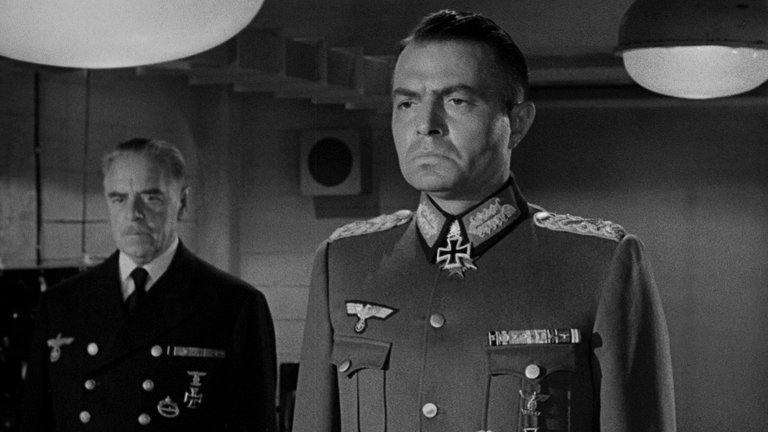
In contemporary Western discourse, a cynical observation often surfaces: that our collective historical memory has been relentlessly narrowed to the narrative of the Second World War. This conflict, stripped of its profound complexity, is reduced to a stark, morally unambiguous template of absolute Good versus absolute Evil—a conveniently simplistic framework that, when required, can be wielded as a potent propaganda tool for contemporary political aims. This perception is, of course, a myth. Like all potent myths, it did not emerge spontaneously but was carefully constructed, and its primary architect in the post-war decades was the dream factory of Hollywood. Few artefacts of this cinematic myth-making were as successful, influential, and intellectually insidious as the 1951 biographical drama The Desert Fox: The Story of Rommel. The film stands as a foundational text in the post-war rehabilitation of the Wehrmacht and a deliberate reshaping of public memory to suit the exigencies of the nascent Cold War.
The film’s origins are crucial to understanding its perspective. It is adapted from Brigadier Desmond Young’s 1950 bestseller, Rommel: The Desert Fox. Young, a British officer captured at the Battle of Gazala in June 1942, had a brief, personal encounter with the then-ascendant Field Marshal Erwin Rommel. Like many of his contemporaries, Young was captivated by Rommel’s reputation for military brilliance and, more importantly, by an aura of chivalric conduct that contrasted sharply with the barbarism associated with the Nazi regime. After the war, Young embarked on what might charitably be called a sympathetic investigation, interviewing Rommel’s widow, Lucie, his son Manfred, and various associates. The resulting book, a sensation in Britain, presented Rommel as the noble, professional soldier, tragically ensnared by a regime he did not wholly endorse. This narrative was catnip to Hollywood producer Nunnally Johnson, who saw in it the potential for a compelling—and commercially viable—human drama, resulting in Henry Hathaway’s 1951 film.
The Desert Fox opens with a bravura, almost proto-action movie sequence: a November 1941 British commando raid on Rommel’s supposed Libyan headquarters. The sequence is taut, violent, and filmed with a gritty immediacy that feels years ahead of its time. Its conclusion, where a wounded commando anxiously asks his captor if they “got him,” sets up Rommel as a mythic figure so pivotal that his mere elimination could alter the war’s course. This thrilling ‘cold open,’ however, proves to be a tonal feint. The film immediately jumps to June 1942, revealing the raid’s failure, and settles into a far drier, more didactic pace. We are shown the dramatised meeting between Rommel (James Mason) and Brigadier Young (played by Young himself, with Michael Rennie’s voiceover narration), a scene that functions less as drama and more as a framing device to legitimise the film’s forthcoming hagiography.
What follows is a selective chronicle of Rommel’s later war. The pivotal Battle of El Alamein is depicted largely through grainy stock footage, emphasising Allied material superiority. Rommel’s frustration is portrayed not as a failure of his own strategy, but as the result of Hitler’s (Luther Adler) fanatical, irrational orders to stand fast and die. Rommel’s decision to retreat against these orders is framed as an act of humane leadership, saving his men for another day. By the time the African campaign collapses in May 1943, the film has established its core dichotomy: the professional, pragmatic soldier versus the ideologically crazed dictator. This theme intensifies in the film’s second half, which focuses on the lead-up to the 20 July plot. Recalled to Europe, Rommel is visited at home by Dr. Karl Strölin (Cedric Hardwicke), who draws him into the nascent conspiracy. The film carefully deals with Rommel’s reluctance, painting him as apolitical and loyal to his oath, yet gradually awakening to the moral necessity of removing Hitler.
The D-Day landings are presented as another failure stemming from Hitler’s delusion (here, bizarrely, attributed to the advice of astrologers) rather than Allied skill or Rommel’s own strategic miscalculations. Following his injury in an Allied air attack, Rommel is convalescing when the assassination attempt fails. The film’s climax is its most powerful sequence: General Burgdorff (Everett Sloane) offers the wounded hero a grim choice—a quiet suicide with honours preserved, or a show trial and disgrace for his family. James Mason’s performance here is masterfully stoic, conveying resigned dignity as he chooses the cyanide capsule. The film concludes with the words of Winston Churchill, praising Rommel’s chivalry and genius, thus providing the ultimate British imprimatur for the myth it has just spent two hours constructing.
And it is a myth, one the film did not create but powerfully codified for a mass audience. The “Rommel myth” was spawned during the war itself, first by Nazi propaganda needing a heroic Aryan commander, and then, ironically, by the British. For figures like Churchill, a supernaturally competent Rommel served as a convenient alibi for British military incompetence in North Africa and his own strategic blunders. Post-1945, this myth was repurposed for a new geopolitical reality. The emerging Cold War required a rehabilitated West Germany as a bulwark against the Soviet Union. To facilitate this, the concept of the “clean Wehrmacht”—the idea that the regular German army was largely separate from the crimes of the SS and the Nazi party—needed promotion. The Desert Fox provided the perfect vehicle: Rommel was not only a genius but also noble, chivalric, and ultimately a martyr who chose the “right side of history.” His portrayed involvement with the 20 July plotters, however tenuous in reality, transformed him from a Nazi general into a proto-anti-Nazi resistance figure, thereby laundering the reputation of the entire German officer corps in the public imagination.
On a purely technical level, the film is competent. Henry Hathaway directs with the same semi-documentary flair he used in The House on 92nd Street, blending staged drama with newsreel footage. James Mason, who actively sought the role, delivers a nuanced and charismatic performance that lends credibility to the whitewashing project. Yet, the film suffers from a profound tonal schizophrenia. Its gripping opening promises a tense war film, but it swiftly devolves into a talky, stage-bound drama that prioritises argument over action. The extensive use of stock footage often feels like a cost-saving measure that distances the viewer from the drama, creating a pedagogical, even propagandistic, feel. It is a film made for an audience that lived through the war, presupposing a familiarity with names, dates, and events that would leave later generations adrift.
The reception at the time was tellingly divided. In Britain, where the public had been steeped in the Rommel legend since the desert war, the film was a success. In the United States, it performed modestly. Critics were polarised. Some praised its bravery in humanising a former enemy, seeing it as a gesture of post-war reconciliation. Others were rightly aghast at its historical revisionism. The author C.S. Forrester, in a famously scathing review, wrote that he wished he could throw grenades at the screen—a visceral rejection of the film’s sanitising agenda. This criticism hits at the film’s core dishonesty: it airbrushes Rommel’s enthusiastic support for the Nazi regime during its victorious years, his closeness to Hitler (who awarded him his field marshal’s baton), and his silence in the face of the Commando Order and other criminal directives. It reduces his late-war disillusionment to a purely military pragmatism, carefully avoiding any serious engagement with the moral catastrophe of the regime he served so effectively.
Nevertheless, The Desert Fox was deemed a moderate commercial success, cementing James Mason’s Hollywood stardom and leading to a reprisal of the role in 1953’s The Desert Rats. Its true legacy, however, is far more consequential than its box office. The film provided a compelling, emotionally resonant blueprint for the rehabilitation of German militarism. By transforming Erwin Rommel into a tragic hero, The Desert Fox actively shaped a politically useful narrative for the future, proving that in Hollywood’s hands, even history’s darkest chapters could be recut into a morally comforting—and deeply misleading—fable.
Ultimately, The Desert Fox is a well-crafted piece of propaganda, arguably more effective for its subtlety than any crude polemic. It exemplifies how cinema, under the guise of biography, can perform profound ideological work, simplifying complex historical figures and laundering uncomfortable truths to suit the needs of the present. In forging the myth of the “good German,” it contributed to a historical amnesia that continues to obscure the full, complicit nature of the Wehrmacht in the horrors of the Third Reich.
RATING: 6/10 (++)
==
Blog in Croatian https://draxblog.com
Blog in English https://draxreview.wordpress.com/
InLeo blog https://inleo.io/@drax.leo
InLeo: https://inleo.io/signup?referral=drax.leo
Leodex: https://leodex.io/?ref=drax
Hiveonboard: https://hiveonboard.com?ref=drax
Rising Star game: https://www.risingstargame.com?referrer=drax
1Inch: https://1inch.exchange/#/r/0x83823d8CCB74F828148258BB4457642124b1328e
BTC donations: 1EWxiMiP6iiG9rger3NuUSd6HByaxQWafG
ETH donations: 0xB305F144323b99e6f8b1d66f5D7DE78B498C32A7
BCH donations: qpvxw0jax79lhmvlgcldkzpqanf03r9cjv8y6gtmk9