Indian Summer (S1x11)
Airdate: 27 September 2007
Written by: Tom Palmer & Matthew Weiner
Directed by: Tim Hunter
Running Time: 46 minutes
The first season of Mad Men is rightly celebrated as one of the finest pieces of television drama ever produced, a masterclass in character study and period atmosphere. Almost every episode is very good, yet some inevitably rank higher than others in the collective critical memory. Those that occupy the lower tiers often do so on account of their conventional narrative choices. Indian Summer, the eleventh episode of the inaugural season, is a prime example. While it delivers several seismic plot developments and pivotal character moments, it does so with a sometimes clumsy hand, marring the subtlety that is the show’s usual hallmark.
The episode opens with an uncharacteristically brutal and direct scene. Adam Whitman, the brother Don Draper paid $5,000 to disappear from his life, is seen in a cheap hotel room. He returns the money in a parcel addressed to Don, then proceeds to hang himself. This stark depiction of suicide immediately sets a darker, more visceral tone than the series’ typical restrained melancholy. It is a raw reminder of the human cost of Don’s fabricated identity and his ruthless severing of past ties. Yet, in a narrative irony that defines much of the episode, Don remains completely oblivious to this tragedy. He is consumed by a corporate crisis at Sterling Cooper.
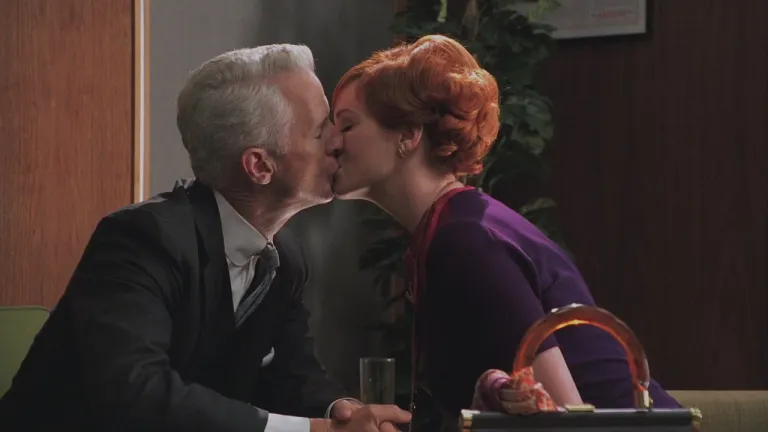
A month after Roger Sterling’s heart attack, the firm’s patriarch, Bert Cooper, is in a panic. Fearing that lucrative clients—particularly the tobacco giant Lucky Strike—might abandon the agency due to the partner’s absence, Bert coerces the barely convalescent Roger to leave his sickbed and make an appearance at the office. Roger’s arrival, supported by his wife Mona and met with staged applause from the staff, is a hollow spectacle. Bert, acutely aware that Roger’s pallor betrays his frailty, devises a characteristically cynical solution. He enlists Joan Holloway, the office manager and Roger’s discreet mistress, for a special task: to apply her expertise with cosmetics to make Roger look healthy. The scene where Joan performs this intimate act is charged with unspoken history; as she applies rouge to his cheeks, they quietly admit they have missed each other, a moment of genuine tenderness amidst the deception. This plot strand showcases the show’s strength in depicting the personal within the professional, yet the premise itself—using a mistress as a makeup artist to deceive a client—borders on the contrived.
The charade, unsurprisingly, fails. During the meeting with Lee Garner Sr. of Lucky Strike, Roger suffers a second, very public heart attack and is stretchered away to an ambulance, his wife Mona cursing Bert for endangering her husband’s life. The business outcome, however, is perversely positive. Garner is impressed by Don Draper’s cool-headed pitches amidst the chaos, and with Roger definitively out of the picture, Bert is forced to promote Don to senior partner. This promotion sets in motion significant changes. Don retains his creative director role but gains a new, larger office. This, in turn, disrupts the expected career path of Peggy Olsen, who will not become his new secretary. Instead, this proves a fortuitous turn for her. Impressed by her work on the Belle Jolie campaign, Don and his team assign her to develop a campaign for the “Relax-a-cisor,” a contraption marketed to help women lose weight. The assignment is tinged with unspoken commentary on Peggy’s own recent weight gain. In testing the device, Peggy makes an accidental discovery: its vibrations, when applied to her genitals, produce pleasure. With dutiful, almost clinical detachment, she reports this finding to the male executives, suggesting how the sensation could be marketed to women. Don, recognising a sharp advertising mind at work, is impressed and promotes her to junior copywriter with a raise. This subplot is the episode’s most clever exploration of its central theme: the awakening and commercial exploitation of female sexuality.
That theme is further explored through Betty Draper’s storyline. With Don spending increasing nights away—often in the bed of department store heiress Rachel Menken—Betty is left in the echoing emptiness of her suburban home. An unseasonably hot autumn day, the ‘Indian summer’ of the title, brings Bob Shaw (Adam Kaufman), an air conditioning salesman, to her door. Despite Don’s prior warnings about strangers, Betty lets him in. Their conversation is a masterpiece of repressed tension and unspoken longing, though it culminates in nothing more than a sales pitch. Later, Don’s anger upon hearing of the visit underscores his controlling nature. More revealing is the scene where Betty catches herself in a vivid sexual fantasy about the young salesman. The episode frames female desire through both Peggy’s pragmatic discovery and Betty’s internal fantasy, linking them via the literal and metaphorical ‘heat’ of the season. This symbolism, however, is where the episode stumbles. The connection between the weather and female frustration is presented with a lack of subtlety that feels heavy-handed compared to the series’ normally nuanced storytelling.
Further evidence of this uneven execution is found in a subplot that feels like unnecessary filler. Peggy’s date with Carl Winter (Aaropn Hill), a young, independent truck driver, is a clunky attempt at social commentary. Their evening ends badly due to differences in class and ambition, highlighting the cultural gulf between Peggy’s burgeoning white-collar aspirations and Carl’s blue-collar worldview. While intended to flesh out Peggy’s character and the era’s social tensions, the scene adds little to the episode’s core narratives and disrupts its pacing.
The episode concludes with a potent cliffhanger that expertly ties its threads together. Don’s old office stands empty. Pete Campbell, who perpetually yearns for Don’s status, wanders in, symbolically occupying the space. A messenger boy, mistaking Pete for Don, delivers the parcel containing Adam Whitman’s returned $5,000 and suicide note. Pete’s possession of this damning evidence about Don’s past sets up immense future conflict, providing a masterful hook for the season’s final episodes.
While the season as a whole excels inn atmospheric recreation of the 1960s while lacking traditional plot—Indian Summer stands out precisely because it does have plot. Writers Tom Palmer and Matthew Weiner pack in dramatic firsts: the series’ first on-screen death and a second, public medical crisis for Roger. More importantly, it engineers momentous changes for two major characters: Don’s ascension to partner and Peggy’s breakthrough into copywriting. These are tectonic shifts in the series’ power dynamics.
Ultimately, Indian Summer is an episode of profound importance to Mad Men’s first season, forcing character evolution and advancing the narrative at a sudden pace. Its exploration of female sexuality, through the dual lenses of commercial exploitation and personal repression, is ambitious and largely successful. However, its achievements are compromised by moments of overly literal symbolism and a tendency towards melodrama that contrasts with the show’s typically refined restraint. It is, therefore, a fascinating but flawed installment: a necessary storm that changes the landscape, even if the thunderclaps are occasionally too loud.
RATING: 7/10 (+++)
==
Blog in Croatian https://draxblog.com
Blog in English https://draxreview.wordpress.com/
InLeo blog https://inleo.io/@drax.leo
LeoDex: https://leodex.io/?ref=drax
InLeo: https://inleo.io/signup?referral=drax.leo
Hiveonboard: https://hiveonboard.com?ref=drax
Rising Star game: https://www.risingstargame.com?referrer=drax
1Inch: https://1inch.exchange/#/r/0x83823d8CCB74F828148258BB4457642124b1328e
BTC donations: 1EWxiMiP6iiG9rger3NuUSd6HByaxQWafG
ETH donations: 0xB305F144323b99e6f8b1d66f5D7DE78B498C32A7
BCH donations: qpvxw0jax79lhmvlgcldkzpqanf03r9cjv8y6gtmk9