The Best of Both Worlds, Part I (S03E26)
Airdate: June 18th 1990
Written by: Matthew Piller
Directed by: Cliff Bole
Running Time: 45 minutes
By the conclusion of its third season, Star Trek: The Next Generation found itself in a position of remarkable strength, a stark contrast to the fate of its predecessor. At the end of The Original Series’ third season, the franchise was languishing; its finale, Turnabout Intruder, was mired in controversy and widely ignored, serving as the ignominious last chapter of a cancelled series representing Star Trek at its nadir. In contrast, the final episode of TNG’s third season represented the franchise not merely at its zenith, but as a promise that the best was yet to come. It capped a highly celebrated season, proving the series had matured enough for its creators to view a fourth season as a certainty. One bold expression of this confidence was the decision to split the season finale, The Best of Both Worlds, into two parts, with a monumental cliffhanger to be resolved months later at the start of the next season. This gamble resulted in what many consider, if not the absolute best, then certainly one of the most memorable and iconic moments in the entire Star Trek canon.
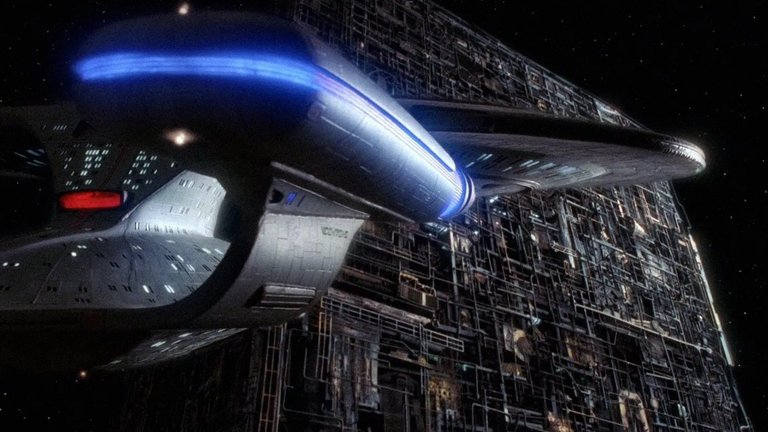
This pivotal episode functions as a direct sequel to the second season's Q Who, an instalment which, after numerous less-successful attempts to craft a new iconic adversary, finally provided the series with its most terrifying and implacable villains: the Borg. The narrative begins with the USS Enterprise-D being dispatched to investigate the fate of the New Providence colony, which sent a distress signal before falling silent. Starfleet Command, represented by Admiral J.P. Hanson (George Murdock), an old friend of Captain Picard, strongly suspects Borg involvement and voices a grave concern: if an invasion is imminent, Starfleet "isn't ready." Hanson departs for Starbase 324, leaving behind Lieutenant Commander Shelby (Elizabeth Dennehy), an officer who has spent the last year studying every available datum on the Borg and is Starfleet's foremost expert. Her arrival immediately injects a new and disruptive energy into the Enterprise’s established hierarchy.
Shelby, characterised by her fierce ambition and assertive, results-driven personality, instantly clashes with Commander William Riker. The conflict is deeply personal; Riker has repeatedly rejected promotions and opportunities to command his own ship, preferring the familiar, esteemed role of First Officer on the Federation flagship. Shelby not only criticises this choice as complacent but actively uses it to challenge his authority and question his commitment, positioning herself as both a rival and a potential successor. This tension is more than mere dramatic filler; it reflects a key behind-the-scenes dynamic. Showrunner Michael Piller, who had been hired for only a single season, was himself contemplating whether to renew his contract. He saw Riker's career dilemma as a parallel to his own professional crossroads, a thematic layer that adds significant depth to the character drama.
These personal stakes are brutally set aside when the Enterprise confronts the genuine, existential threat. Upon finding only a vast, smouldering crater where New Providence once stood, Shelby confirms the presence of Borg signatures. The crew is forced to confront a terrible realisation: the Borg invasion of the Federation has begun. The subsequent destruction of the USS Lalo leads the Enterprise to a colossal Borg cube, already en route to Earth. Faced with impossible odds, Picard displays a steely resolve, determined to engage the cube and buy precious time for Starfleet to mobilise a defence. The episode masterfully escalates the tension from investigation to dread, and finally to a desperate battle for survival.
The confrontation is chilling. The Borg cube hails the Enterprise, addressing Picard by name and demanding unconditional surrender—a display of chilling intelligence and personal targeting. Picard’s defiant refusal leads to a brutal first exchange of fire, which leaves the Enterprise damaged and forced to retreat into the volatile Paulson Nebula. A clever subplot emerges as Chief Engineer Geordi La Forge theorises that reconfiguring the main deflector dish into a weapon could damage the cube, though the tactical window to use it is vanishingly small. This scientific problem-solving provides a classic Star Trek counterpoint to the overwhelming military threat.
The episode’s most devastating turn occurs after the Enterprise emerges from the nebula. Three Borg drones beam directly onto the bridge, a breathtaking violation of the ship’s sanctum, and abduct Captain Picard. He is transported to the Borg cube and subjected to the horrific process of assimilation. A desperate away team, led by Riker, beams over in a futile attempt to rescue him. While they fail to recover Picard, Dr. Crusher hypothesises that their sabotage may have caused enough disruption to grant the Enterprise a brief advantage. The episode concludes with its iconic, gut-wrenching cliffhanger. Picard, now transformed into the Borg spokesman Locutus, appears on the viewscreen. In a cold, synthesised voice that nonetheless retains a ghost of Picard’s cadence, he demands the Enterprise’s surrender. Riker, now in command and with Shelby at his side, hesitates for a moment that feels like an eternity before giving the fateful order: "Fire." The screen cuts to black with the words "To Be Continued..."—a television moment that has become legendary.
The confidence Paramount had in the series by this point is reflected in the production. The episode was granted a larger budget, and it shows on screen under the confident direction of Cliff Bole, a series veteran known for handling action with clarity and scale. The special effects, particularly the intimidating Borg cube and the dazzling weapons fire, are superior to the series’ usual standard. Even the matte painting of the New Providence crater is impressively rendered, selling the scale of the destruction. While the episode recycles Borg costumes and props from Q Who, their re-use here feels economical rather than cheap, and Ron Jones’s inspired, relentless score enhances their otherworldly and menacing presence.
As noted, the writing was similarly inspired and deeply personal for Michael Piller. The Riker-Shelby dynamic elevates the episode from a simple invasion story into a compelling study of command, ambition, and maturity. Riker is portrayed as more experienced yet more vulnerable than ever before, suddenly burdened with the ultimate responsibility and faced with a rival who embodies a younger, more energetically ruthless version of himself. This complexity ensures the episode’s drama remains compelling beyond the sci-fi spectacle.
Furthermore, The Best of Both Worlds, Part I raises the narrative stakes higher than perhaps any prior Star Trek episode. While the Enterprise and its crew had faced dire threats before, the episodic nature of the series traditionally guaranteed a resolution within the hour. Here, that contract is shattered. A scene of profound gravity between Picard and Guinan underscores this shift; as Picard contemplates the potential extinction of humanity, his fear is palpable and utterly justified. The Borg are presented as indestructible, unstoppable, and utterly incapable of being reasoned with. By the end of the episode, a disaster of monumental proportions has occurred: Picard has lost his humanity and been transformed into the very avatar of the enemy.
The episode also represented a formal landmark. It was the first two-part story in Star Trek since The Menagerie in TOS’s first season. However, whereas that earlier two-parter was born from necessity—to utilise existing footage and keep the show on air—The Best of Both Worlds was conceived from the outset as a two-part narrative. More audaciously, it was the first to be split across two separate seasons. The cliffhanger was phenomenally effective in the summer of 1990, leaving fans in agonised suspense for three months, debating whether Patrick Stewart might actually leave the series. For a modern, perhaps more cynical audience accustomed to serialised storytelling, this structural choice might appear less revolutionary. It could even be viewed as a somewhat manipulative tactic, reminiscent of prime-time soap opera cliffhangers like "Who Shot J.R.?" or Dynasty’s "Moldavian Massacre." The abrupt cut to "To Be Continued..." following Riker’s command can, in hindsight, feel overly convenient and slightly damaging to the suspension of disbelief, highlighting the artificiality of the season break.
Nevertheless, "The Best of Both Worlds, Part I" is an exceptional episode of television, firmly within the high standards of Star Trek’s golden age. It masterfully combines high-concept science fiction, intense personal drama, and unparalleled tension. It serves as a perfect exemplar of why the series finally captured the hearts of the audience and critics alike, and why so many, including future franchise stewards like Brannon Braga, fell in love with Star Trek: The Next Generation after witnessing its power. It is a landmark piece of storytelling that, despite an arguably dated cliffhanger structure, retains its visceral impact and thematic richness, securing its place as one of the finest hours the franchise has ever produced.
RATING: 8/10 (+++)
Blog in Croatian https://draxblog.com
Blog in English https://draxreview.wordpress.com/
InLeo blog https://inleo.io/@drax.leo
LeoDex: https://leodex.io/?ref=drax
InLeo: https://inleo.io/signup?referral=drax.leo
Hiveonboard: https://hiveonboard.com?ref=drax
Rising Star game: https://www.risingstargame.com?referrer=drax
1Inch: https://1inch.exchange/#/r/0x83823d8CCB74F828148258BB4457642124b1328e
BTC donations: 1EWxiMiP6iiG9rger3NuUSd6HByaxQWafG
ETH donations: 0xB305F144323b99e6f8b1d66f5D7DE78B498C32A7
BCH donations: qpvxw0jax79lhmvlgcldkzpqanf03r9cjv8y6gtmk9