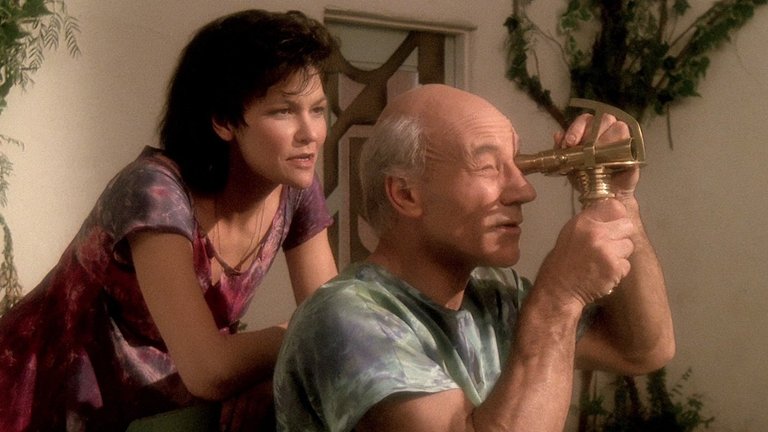
The Inner Light (S05E25)
Airdate: 1 June 1992
Written by: Morgan Gendel & Peter Allan Fields
Directed by: Peter Lauritson
Running Time: 46 minutes
Star Trek: The Next Generation and its seven-year run is almost universally hailed as the Golden Age of Star Trek, and many aficionados consider it the finest piece of the entire franchise. The consistently high quality throughout the seasons, however, made the answer to the question of which TNG episode is the very best very difficult to answer. One of the candidates, at least in the latter stages of the series, and certainly one of the most memorable instalments, is The Inner Light, the penultimate episode of Season 5.
The plot begins in the Pevenium system, where the USS Enterprise-D, during routine exploration, notices a mysterious space probe. The probe emits a nucleonic beam that strikes Captain Picard; he is rendered unconscious and brought to sickbay where Dr Crusher must fight for his life. This inciting incident sets the stage for one of the most intimate and unusual stories in the Trek canon.
Picard wakes up near a strange woman (Margot Rose) who addresses him as "Kamin". He leaves the house and comes to a town square where a local dignitary named Battai (Richard Riehle) is holding a speech. It is revealed that the community is called Ressik, that Batai is "Kamin"'s good friend, and that the planet is called Kataan. Picard is at first sceptical, but none of the people have heard about aliens and space travel, and Picard gradually begins to play along and accept his new identity. The slow unveiling of this world is masterfully handled, drawing the viewer into the same confusion and eventual acceptance that Picard experiences.
The years pass, and Kamin, like the rest of the community, experiences a devastating drought. He suggests some technical solutions to Battai, but they are rejected by the local authorities. Picard/Kamin starts playing a flute, with the melody of Frère Jacques the only reminder of his old life. This musical motif becomes the emotional anchor of the episode, a thread connecting his two existences.
More years have passed, and Kamin has an enlarged family – a son named Batai (played by Daniel Stewart, Patrick Stewart's real son), named after Batai who had died, and a daughter named Meribor (played by Jennifer Nash). Kamin and Meribor discover that the soil has begun to be affected by radiation, threatening all life on the entire planet. Even more years pass and Kamin learns that the planet is doomed, with the Kataans and their primitive space technology being able only to launch a space probe that would tell the universe of their existence. The tragedy is all the more poignant because the viewer knows, as Picard knows, that this civilisation is already extinct.
Kamin, now visibly aged, comes to attend the launch ceremony, but, much to his surprise, he sees his old friend Batai alive and in his prime, together with younger versions of his friends and family. They tell him that they are part of the probe which has been seeking for the "teacher" – a conduit for their experience and lore. This revelation reframes the entire experience: Picard was not merely a passive observer but the chosen vessel for an entire civilisation's memory.
Picard is awakened on the Enterprise and learns that the whole experience lasted for only half an hour. The probe is traced to a star system that has been destroyed by a supernova thousands of years ago. It was Kataan's probe that found him and helped him resurrect the dead people in his own mind. At the end of the episode, Picard is given the flute from the probe and he begins to play it in the way he has learned in his vision, a haunting and deeply moving conclusion.
The episode originated from Michael Piller's idea that an episode of TNG should depict Picard's unlived life, a piece of pure speculation. The refinement of the concept was a very hard and arduous process, with Morgan Gendell, co-author of the script, being inspired by memories of the Holocaust among Jewish people and the difficulties of those horrors being imagined by newer generations. The title was taken from a relatively obscure 1968 song by The Beatles, the B-side to the Lady Madonna single, lending the episode an additional layer of cultural resonance.
The episode, directed by Peter Lauritson, excels at the slow burn, with Picard's condition and the mystery of his alternative life being only gradually resolved. The result is very strong and very emotional. The tragic fate of the Kataans is in some ways inspired by real-life concerns of late 20th Century Earth about environmental apocalypse caused by the ozone layer hole or global warming, giving the story a prescient and urgent subtext.
Patrick Stewart probably delivered the greatest performance in the series, managing to convey an almost entire lifetime, with changes from disbelief to acceptance, in the manner of less than an hour of screen time. His physical transformation, the subtle shifts in posture, voice, and bearing as Kamin ages, is nothing short of extraordinary. The episode also excelled in direction, production, and costume design, which made the Kataans look Earth-like yet alien enough, creating a believable and lived-in world.
Richard Riehle, a character actor known for playing middle-aged or elderly characters, here plays an unusually young character who, unlike any other Kataan character, never ages. This is a clever narrative device: Batai remains eternally young because he exists in the probe's simulation as a fixed point, the friend who greets each new "teacher".
The production team later admitted that the impact of the episode was much greater than they had anticipated. Having lived an entire life, experiencing growing old and having a family, has profoundly changed Picard from the character introduced at the beginning of the series. The TNG staff had to address these issues and refer to them in the next two seasons and the TNG feature films, making The Inner Light not just a standalone masterpiece but a pivotal character moment that rippled through the rest of the franchise.
The episode is considered one of the highest rated on IMDb and on many fan lists. It won the Hugo Award for Best Dramatic Presentation, the third Star Trek episode to do so, and the first of two TNG episodes to achieve that honour. In the end, The Inner Light succeeds because it dares to slow down, to be quiet, to be sad. It is a meditation on memory, legacy, and the value of a single life lived fully, and it remains, by any measure, one of the finest pieces of television ever produced.
RATING: 9/10 (++++)
Blog in Croatian https://draxblog.com
Blog in English https://draxreview.wordpress.com/
InLeo blog https://inleo.io/@drax.leo
LeoDex: https://leodex.io/?ref=drax
InLeo: https://inleo.io/signup?referral=drax.leo
Hiveonboard: https://hiveonboard.com?ref=drax
Rising Star game: https://www.risingstargame.com?referrer=drax
1Inch: https://1inch.exchange/#/r/0x83823d8CCB74F828148258BB4457642124b1328e
BTC donations: 1EWxiMiP6iiG9rger3NuUSd6HByaxQWafG
ETH donations: 0xB305F144323b99e6f8b1d66f5D7DE78B498C32A7
BCH donations: qpvxw0jax79lhmvlgcldkzpqanf03r9cjv8y6gtmk9