Time’s Arrow (Part I) (S05E26)
Airdate: 15 June 1992
Written by: Joe Menosky & Michael Piller
Directed by: Les Landau
Running Time: 46 minutes
When Star Trek: The Original Series was conceived, a five-season run was the ambition; it was a benchmark never reached in its initial incarnation. Ironically, it fell to its successor, Star Trek: The Next Generation, to achieve that longevity mere months after the death of the franchise’s creator, Gene Roddenberry. As the end of TNG’s fifth season approached in 1992, a wave of rumours concerning the series’ imminent cancellation swept through Trek fandom. While genuine behind-the-scenes discussions were undoubtedly occurring—primarily concerning the new creative direction and the development of the spin-off that would become Deep Space Nine—the future of The Next Generation was not seriously in doubt at that juncture. Nevertheless, executive producer Michael Piller decided to quash the speculation decisively by crafting a season finale that would end on a cliffhanger, thereby serving as the first instalment of a two-part story and signalling the show’s continued life. That episode, originally aired simply as Time’s Arrow and only retroactively titled Part I, is a fascinating but flawed piece of television, one whose construction feels more like a corporate statement than organic storytelling.
The plot begins with an intriguing, if somewhat gimmicky, premise. The USS Enterprise-D is summoned to Earth following an archaeological discovery near San Francisco: a cache of artefacts dating back 500 years, which includes a severed head identical to that of the android Lieutenant Commander Data. Data himself confirms the grisly find, concluding through a series of logical leaps that he must have travelled back to the late 19th century and been decapitated. His reaction is curiously philosophical; he appears almost relieved by this evidence of his own mortality, viewing it as a step towards his perennial goal of becoming more human. This character beat is one of the episode’s stronger moments, lending emotional weight to what is otherwise a forensic puzzle.
Captain Picard, ever the pragmatist, focuses on the more immediate mystery: the archaeological site also contains traces of shapeshifting aliens from the planet Devidia II. The Enterprise travels to that world, where an away team explores subterranean caves. Counsellor Troi senses the presence of suffering humans, later established to be out of phase with normal spacetime. Data, whom Picard reluctantly allows on the mission, uses a self-built device to phase-shift and observe the aliens directly. He follows two humanoid figures into what appears to be a temporal portal and is violently sucked into the past.
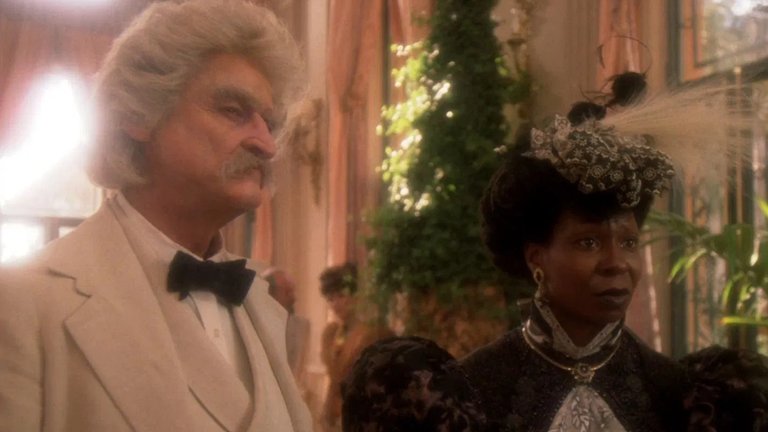
Thus, Data finds himself in San Francisco in 1893. Despite his anachronistic appearance, he manages to secure aid from locals, including a bellhop who is revealed to be the future famous author Jack London (Michael Aron). In a delightful sequence, Data wins a considerable sum at a poker game, procures period-appropriate clothing, and begins constructing a device to signal the Enterprise. While perusing a newspaper, he sees a photograph of Guinan, the Enterprise’s mysterious bartender. Believing her to be a fellow time traveller, he seeks her out, only to find her in the company of Samuel Clemens, better known as Mark Twain (Jerry Hardin). In a clever twist, Data discovers that this is a younger Guinan who has not yet met him, their first encounter lying centuries in the future. Twain, ever the sceptic and raconteur, becomes intensely intrigued by Data. The final scene returns to Devidia II, where the away team, using Data’s device, deduces that the aliens are travelling to the past to feed on human neural energy. The team decides to follow them through the portal to prevent their predations, leaving the audience with a classic cliffhanger.
By this point in Star Trek’s history, some of the franchise’s most celebrated entries—such as The City on the Edge of Forever and Star Trek IV: The Voyage Home—had already masterfully utilised the concept of time travel. The writers of “Time’s Arrow” cannot therefore be faulted for returning to a proven narrative well. Yet, the decision to set another time-travel story in San Francisco and to populate it with famous figures from American literature cannot help but feel strangely redundant and parochial for a series that had, by its fifth season, boldly explored a much wider universe. Indeed, the production team reportedly considered other time periods, including the 1990s, but rejected it as having “been done” in Star Trek IV. This admission underscores a creative timidity; rather than seeking a fresh historical context, the episode retreats to a familiar, almost touristy, version of the past. The result is a story that feels smaller than the Enterprise’s usual remit.
That said, there are far worse historical personages to incorporate than Mark Twain, and Jerry Hardin, a superb character actor of his generation, attacks the role with palpable gusto. His performance is a highlight, infusing the episode with wit and a sceptical energy that contrasts effectively with Data’s literalism. Hardin was reportedly so enamoured with the part that he later developed a one-man stage show based on Twain’s character, a testament to the depth of his engagement. The episode also features a brief but notable appearance by Marc Alaimo—sans his usual heavy prosthetics—as the card shark Frederick La Roque. This marked his fourth and final appearance on TNG before his iconic tenure as Gul Dukat on Deep Space Nine, offering a neat piece of franchise trivia for dedicated viewers.
The episode’s most significant flaw, however, lies in its very raison d’être: the cliffhanger. Combined with the conspicuously artificial “Hollywood backlot” aesthetic of its 1893 San Francisco sets, this narrative device renders the episode feeling overly constructed and insubstantial, lacking the rounded completeness of Star Trek’s best standalone stories. More damningly, the cliffhanger itself lacks the gut-wrenching urgency and existential dread that made The Best of Both Worlds, Part I the gold standard for Next Generation two-parters. Here, the jeopardy feels manufactured rather than organic; the crew is pursuing a threat they have only just identified, and the temporal mechanics are explained via a torrent of confusing technobabble that even a dedicated reviewer found excessive. This narrative sloppiness extends to the core logic of the plot. The aliens’ motive for time-traveling to feed is never satisfactorily explained.
Ultimately, Time’s Arrow, Part I is a mixed bag. It possesses undeniable charm in its performances and in the inherent fun of seeing Data navigate the 19th century. Its critical reputation is not without merit, having been ranked among the best time-travel episodes and overall Star Trek instalments by various publications in later years. Yet, these accolades perhaps speak more to the enduring affection for the characters and the era than to the episode’s inherent quality. Viewed dispassionately, it is a product of its specific moment in television history: a somewhat anxious response to network rumours, a safe retreat to a well-trodden narrative template, and a setup for a conclusion that would, in part, have to resolve its own contrivances. As a piece of Star Trek history, it is essential viewing; as a piece of storytelling, it is competent but unspectacular, a stepping stone rather than a destination.
RATING: 5/10 (++)
Blog in Croatian https://draxblog.com
Blog in English https://draxreview.wordpress.com/
InLeo blog https://inleo.io/@drax.leo
LeoDex: https://leodex.io/?ref=drax
InLeo: https://inleo.io/signup?referral=drax.leo
Hiveonboard: https://hiveonboard.com?ref=drax
Rising Star game: https://www.risingstargame.com?referrer=drax
1Inch: https://1inch.exchange/#/r/0x83823d8CCB74F828148258BB4457642124b1328e
BTC donations: 1EWxiMiP6iiG9rger3NuUSd6HByaxQWafG
ETH donations: 0xB305F144323b99e6f8b1d66f5D7DE78B498C32A7
BCH donations: qpvxw0jax79lhmvlgcldkzpqanf03r9cjv8y6gtmk9