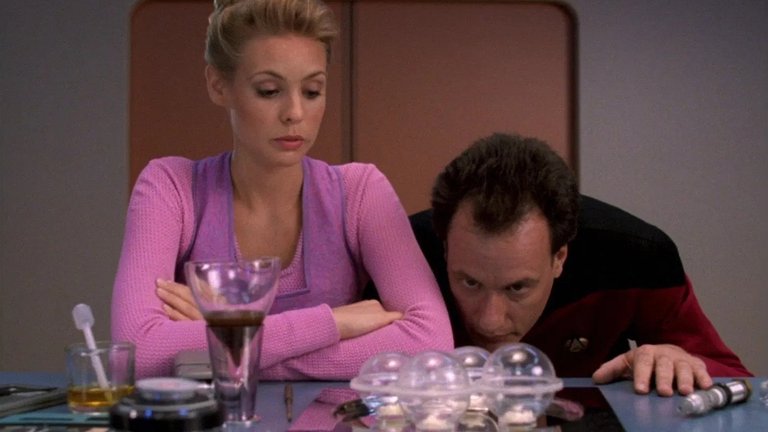
True Q (S06E06)
Airdate: 26 October 1992
Written by: René Echevarria
Directed by: Robert Scheerer
Running Time: 46 minutes
The enduring brilliance and strength of Star Trek: The Next Generation were not immediately apparent at its inception, although, in retrospect, one could have sensed its potential with the arrival of Q in the pilot episode. As the franchise's most iconic recurring character, Q has utilised his unique combination of godlike powers and roguish humour to torment Captain Picard and the crew of the Enterprise-D, all while thoroughly entertaining the audience. However, the writers of TNG demonstrated a shrewd understanding that they had to be economical with Q; had he appeared too frequently, much of his mystique would have evaporated, leading to diminished returns—a fate that, to a degree, later befell the Borg. After a conspicuous absence throughout the entirety of the show's fifth season, Q compensated by appearing in two episodes of Season Six, also making his debut in the spin-off series Deep Space Nine. The first of these was True Q, an episode that attempts to explore the nature of the Q Continuum through a human lens, with decidedly mixed results.
The plot begins at Starbase 112, where the USS Enterprise-D is preparing to deliver aid to the inhabitants of Tagra IV, a planet suffering an ecological disaster. A young Starfleet intern, Amanda Rogers (Olivia d'Abo), boards the ship to study botany under the tutelage of Dr. Crusher. It soon transpires that Amanda possesses unusual, reality-altering powers—she can make her pet dogs appear and vanish at will. These abilities become catastrophically apparent to the entire crew when she unconsciously contains a runaway warp core breach, an event that serves as the catalyst for the episode's central conflict.
Q (John de Lancie) promptly arrives, explaining that the warp core incident was his own doing, engineered merely to test whether Amanda harbours Q-like powers. He reveals that Amanda was conceived by two members of the Q Continuum who chose to live as humans, relinquishing their omnipotence. Sent to investigate, Q declares that Amanda, as a human-Q hybrid, could inadvertently destroy the entire galaxy and that he may have to kill her as he did her parent. He admits that the "freak tornado" in Kansas that killed them was his execution. Q offers her a stark choice: join the Q Continuum or continue to live as a human, but with her powers permanently removed. He chillingly notes that her parents were given the same choice but were unable to resist using their abilities, which led to their demise.
Amanda struggles profoundly with this ultimatum, a turmoil compounded by a budding romantic attraction to Commander Riker. The episode devotes significant time to her conversations with Dr. Crusher, who serves as a sympathetic mentor, and to the ethical debates between Picard and Q. In the climax, Amanda makes her choice not through action, using her nascent powers to prevent a catastrophic reactor meltdown on Tagra IV. Having demonstrated her "true Q" nature, she decides to leave the Enterprise and join the Continuum, though she wins a small reprieve to say farewell to her family and friends.
The script by René Echevarria was based on a spec script submitted by Howard Corey, a teenage fan. According to production staff testimonies, the script underwent numerous changes, including the gender of the protagonist—Corey's original version featured a male character. Early drafts reportedly included Wesley Crusher, a teenage romance, and an unwanted pregnancy, elements that were wisely jettisoned. This problematic genesis perhaps explains some of the episode's lingering awkwardness, particularly in the forced romantic subplot.
John de Lancie is, as ever, magnificent in the role. He reportedly appreciated the script as an opportunity to portray a meaner, more sinister version of Q, harkening back to the character's more dangerous early appearances rather than the gentler comic relief he sometimes became. Ironically, de Lancie later expressed dissatisfaction with the final result, though his performance remains a highlight. His delivery of the line, "Jean-Luc, sometimes I think the only reason I come here is to listen to these wonderful speeches of yours," is an instant classic, perfectly encapsulating Q's amused contempt for Picard's earnestness.
The existential choice given to Amanda is simple and comprehensible. The episode benefits a lot by Olivia d'Abo's excellent performance. The English actress, best known for film roles in Conan the Destroyer and Bolero, brings a compelling mixture of vulnerability, intelligence, and warmth to Amanda, creating one of the most attractive and memorable guest characters in the series' history. Her scenes with Gates McFadden's Dr. Crusher are particularly effective, giving Crusher a larger and more substantive role than usual.
The episode is competently directed by Robert Scheerer, who makes good use of colour and manages the pacing adequately. The special effects, particularly the warp core containment and the resolution on Tagra IV, are solid for early-1990s television. Yet, the production is occasionally let down by questionable choices, most notably in wardrobe. Amanda's fantasy sequence with Riker, which dresses them as protagonists from a 19th-century romantic novel, feels like an unnecessary and painfully clichéd visual trope. It undermines the episode's serious themes and serves as a reminder of the series' occasional tonal missteps.
Critically, True Q is a divisive entry. Some reviewers find it a "snoozer" or "among the least" fun of the Q episodes, criticising its familiar plot—reminiscent of the Season One episode Hide and Q—and its contrived central dilemma. Others praise its lovely moral lesson" and the provocative questions it raises about omnipotence and humanity. A significant flaw, often cited, is the narrative convenience that Amanda's powers only manifest upon boarding the Enterprise, a hurdle the audience is asked to overlook.
True Q is a mid-tier Next Generation episode. It is elevated by strong performances from de Lancie and d'Abo, some effective philosophical dialogue, and the reliable presence of Q. However, it is weighed down by a derivative plot, a simplistic central conflict, and occasional lapses into melodrama and cliché. It functions adequately as a vehicle to explore the Q mythology and provides a satisfactory character study, but it lacks the ingenuity, depth, and sheer audacity that characterise the series' very best instalment. It is, ultimately, a competent but unexceptional chapter in the storied saga of the Enterprise-D.
RATING: 6/10 (++)
Blog in Croatian https://draxblog.com
Blog in English https://draxreview.wordpress.com/
InLeo blog https://inleo.io/@drax.leo
LeoDex: https://leodex.io/?ref=drax
InLeo: https://inleo.io/signup?referral=drax.leo
Hiveonboard: https://hiveonboard.com?ref=drax
Rising Star game: https://www.risingstargame.com?referrer=drax
1Inch: https://1inch.exchange/#/r/0x83823d8CCB74F828148258BB4457642124b1328e
BTC donations: 1EWxiMiP6iiG9rger3NuUSd6HByaxQWafG
ETH donations: 0xB305F144323b99e6f8b1d66f5D7DE78B498C32A7
BCH donations: qpvxw0jax79lhmvlgcldkzpqanf03r9cjv8y6gtmk9