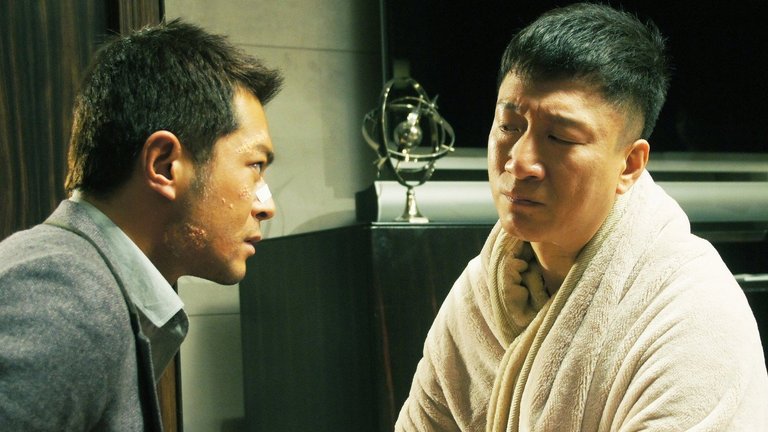
Johnnie To enjoys a reputation as one of the most successful and internationally renowned Hong Kong filmmakers of the 21st century. Much of this esteem is owed to his skilful handling of the gangster genre, for which Hong Kong cinema was best known in past decades. With his 2012 film Drug War, however, he ventured slightly outside those well‑worn genre parameters, weaving together elements of police procedural, action thriller and, somewhat unusually, the road movie. This ambitious amalgamation results in a taut, brutal, and distinctly mainland Chinese crime epic that both honours and subverts the traditions of Hong Kong action cinema.
The film’s relocation to mainland China is a structural necessity for its road‑movie aspirations. Hong Kong’s cramped urban landscape offers little scope for the long, open roads that define the genre. Consequently, the plot is set in the industrial zones and highways around Tianjin, a major northern port. The narrative engine ignites when Timmy Choi (Louis Koo) crashes his car into a restaurant. Hospitalised, his plight coincides with a police crackdown on his drug‑mule operation. Captain Zhang (Sun Honglei) quickly deduces Choi is the survivor of a catastrophic meth‑lab explosion that killed his family. Facing China’s mandatory death penalty for drug manufacturing, Choi’s attempted flight from hospital fails, forcing him into a desperate bargain: he will betray his upstream partners—the flamboyant fishing magnate Bro Haha (Ping Hao) and the shadowy kingpin Uncle Bill (Zhenqi Li)—in exchange for his life. This sets in motion a complex series of undercover stings, with Zhang reluctantly posing first as Choi’s new partner and then as Haha himself. The procedural mechanics are meticulous, but To masterfully tightens the screws; two of Choi’s henchmen escape a police raid, and Choi’s own commitment to the deal begins to waver, seeding the dread that the entire operation is spiralling towards disaster.
Drug War is a profoundly unusual film, particularly for audiences accustomed to Hong Kong genre fare. Its status as a co‑production between Hong Kong and mainland studios necessitated, and surprisingly benefited from, a stark authenticity. The mainland authorities, it seems, did not object to the film’s unflinching portrayal of less‑than‑commendable realities: rampant drug crime, a desperate underclass willing to risk death by becoming “mules” with ingested drug capsules, and the sheer bureaucratic scale of the police response. This grants the film a gritty, almost documentary‑like texture that distinguishes it from the more stylised moral universes of To’s earlier works like Election or PTU. It is a film that acknowledges the People’s Republic not as a monolithic entity but as a vast, conflicted landscape where high‑tech policing battles entrenched, desperate criminal enterprise.
To and his cinematographer Cheng Siu‑keung make brilliant use of this northern Chinese setting. The open, often desolate spaces—framed under a pallid, cold sky—create a sense of bleak isolation that mirrors the characters’ moral desolation. This is not the neon‑drenched, rain‑slicked Hong Kong of noir tradition; it is a world of concrete, steel, and frost. Conversely, the film equally portrays modern China as a surveillance state where technology is a key battleground. The police, with their access to vast databases, omnipresent CCTV, and Zhang’s own dogged experience, consistently hold the upper hand in information warfare. This technological realism grounds the cat‑and‑mouse game, making the eventual unravelling not a failure of intelligence, but a tragic consequence of human unpredictability and violent chance.
And unravelling it does, with a ferocity that remains shocking. The film’s commitment to visceral realism is established early with grotesque, matter‑of‑fact scenes of drug mules being forced to defecate under police watch. It escalates in a central, unbearably tense sequence where Captain Zhang, to maintain his cover as Haha, must inject himself with methamphetamine, his salvation relying on the advice of the very man he is trying to convict. Yet this all serves as a prelude to the film’s devastating final act. The plot’s carefully constructed house of cards collapses into near‑Jacobean levels of bloodshed. In a prolonged, chaotic shootout at a primary school, allegiances shatter and bodies fall with ruthless impartiality. The violence is graphic, messy, and punctuated with startling details of bodily fluids and brutal physics.
This carnage sets the stage for one of modern cinema’s most chilling and memorable conclusions. The actual final scene returns to a cold, procedural silence. Choi, having survived the bloodbath only to be captured, is strapped to a gurney. In a desperate, futile bid to bargain, he spews names and dates as a prison official administers the lethal injection. His voice slows, slurs, and stops. It is a stark, unglamorous depiction of state execution, a rare and courageous ending for a gangster film that pointedly refuses any catharsis or redemption. The law, impersonal and absolute, has the final word.
For all its impressive power, Drug War is not a flawless film. Its principal weakness, as noted, stems from its sprawling narrative ambition. The relatively large number of secondary characters—police subordinates, various gangsters—means many are sketched too thinly. The audience has little time to become attached to their fates, which can dilute the emotional impact of the later massacre. While this perhaps intentionally mirrors the impersonal machinery of both the drug trade and the police state, it does create a certain emotional distance at the very moment the film seeks to overwhelm.
Despite this flaw, Drug War proved to be a massive box‑office hit in both China and Hong Kong, a testament to its gripping execution and topical ruthlessness. Its influence extended beyond borders, inspiring a 2018 South Korean remake, Believer, which later spawned a sequel. Over a decade on, Drug War appears as a pivotal work in Johnnie To’s filmography. It represents a successful grafting of his genre mastery onto a new, harsh national canvas, producing a police thriller of exceptional tension and a bleak, enduring commentary on crime, punishment, and the desperate calculus of survival under the shadow of the death penalty.
RATING: 7/10 (+++)
==
Blog in Croatian https://draxblog.com
Blog in English https://draxreview.wordpress.com/
InLeo blog https://inleo.io/@drax.leo
InLeo: https://inleo.io/signup?referral=drax.leo
Leodex: https://leodex.io/?ref=drax
Hiveonboard: https://hiveonboard.com?ref=drax
Rising Star game: https://www.risingstargame.com?referrer=drax
1Inch: https://1inch.exchange/#/r/0x83823d8CCB74F828148258BB4457642124b1328e
BTC donations: 1EWxiMiP6iiG9rger3NuUSd6HByaxQWafG
ETH donations: 0xB305F144323b99e6f8b1d66f5D7DE78B498C32A7
BCH donations: qpvxw0jax79lhmvlgcldkzpqanf03r9cjv8y6gtmk9