Denys Arcand is one of the most prominent figures in Canadian cinema, at least within the sphere of Québécois filmmaking. He is perhaps best known to international audiences for winning the Academy Award for Best Foreign Language Film with his 2003 drama The Barbarian Invasions (Les Invasions barbares). That critically lauded work was, in fact, a sequel to his 1986 humorous drama The Decline of the American Empire (Le Déclin de l'empire américain), a film that itself brought Arcand considerable international fame and remains one of the most commercially successful Canadian films of its era. While its successor secured Oscar glory, the original Decline offers a fascinating, talkative, and deliberately static portrait of middle-aged intellectual ennui, a film that is as insightful as it is occasionally frustrating in its execution.
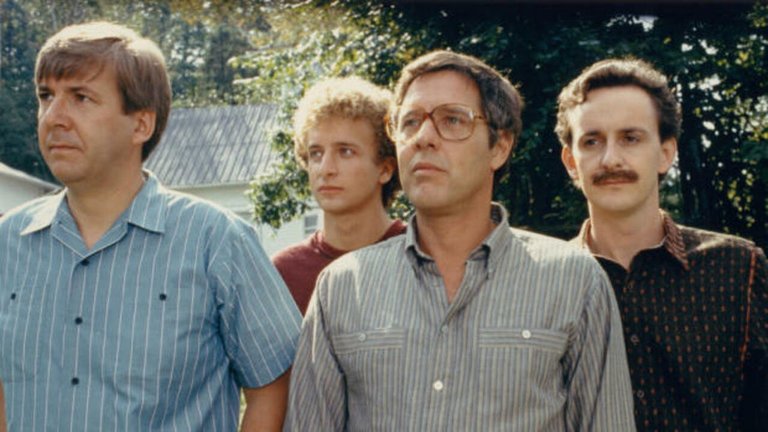
The plot is deceptively simple, unfolding over a single day. It follows a group of friends, mostly middle-aged academics teaching at the Université de Montréal, as they prepare for a dinner party. The narrative is bifurcated: the women—Dominique (Dominique Michel), Diane (Louise Portal), Louise (Dorothée Berryman), and the much younger student Danielle (Geneviève Rioux)—spend their afternoon at a health club, while the men—Rémy (Rémy Girard), Pierre (Pierre Curzi), and Claude (Yves Jacques)—cook at a countryside cottage. The titular decline refers to a thesis from a book by Dominique, a history professor. In a radio interview with her friend Diane, a part-time journalist, she posits that as empires decay, the public good is abandoned in favour of personal pleasure—a diagnosis she applies to the American empire, of which Quebec is a peripheral component. This intellectual framework hangs over the entire film, implicitly criticising the characters’ own self-absorbed pursuits.
The conversation in both groups is dominated almost entirely by sex: its role in their lives, their past exploits, and its impact on their relationships. Arcand presents a panoramic view of sexual attitudes. The men’s talk is boastful and often crude; Rémy is a philandering husband, while Pierre recounts meeting Danielle when she worked in a massage parlour. Claude, an openly gay art professor, vividly describes cruising for men with a reckless hedonism that masks private health anxieties. Among the women, the discussions are more analytical but equally preoccupied. The party is later joined by Mario (Gabriel Arcand), Diane’s uneducated, “punkish” boyfriend, whose relationship with her is founded on unorthodox sexual practices.
This relentless focus on carnality led many contemporary American critics, such as Roger Ebert, to label the film a Canadian answer to Lawrence Kasdan’s The Big Chill (1983). Kasdan’s filmalso deals with a reunion of university friends confronting middle age and lost idealism, albeit triggered by a suicide. However, this comparison is somewhat superficial. Arcand had little interest in crafting a generational statement or exploring the political disillusionment of baby boomers. Instead, as he has indicated, the film originated from a formal challenge: how to make a compelling drama where “nothing happens” and characters merely talk. His solution was to make sex the universal subject, a topic guaranteed to engage both his characters and the audience.
Arcand does not shy away from illustrating these conversations visually. The film features both male and female nudity and relatively explicit sex scenes, though they are presented without sensationalism. To break the potential monotony of continuous dialogue, Arcand employs brief flashbacks that visualise the characters’ anecdotes, such as Pierre’s first encounter with Danielle. These moments are effective, grounding the often-abstract discussions in tangible, if fleeting, memories. The overall tone is one of sophisticated, witty banter, maintaining a generally pleasant and ironic atmosphere. However, darker, more serious dramatic currents surface towards the end, particularly when Louise discovers humiliating truths about her husband Rémy’s infidelities. This shift introduces a poignant note of betrayal and sadness that contrasts sharply with the preceding intellectual jesting.
The film’s success hinges largely on its extraordinarily talented ensemble cast. The performances feel natural and lived-in, with Rémy Girard and Gabriel Arcand (the director’s brother) being particular standouts.The casting is a significant strength, making these often self-absorbed and verbose characters remain watchable and, at times, sympathetic.
An interesting formal choice by Arcand was his deliberate decision to make his protagonists intellectuals. As per his own comments, this allowed them to speak the “proper” French of the educated elite rather than using a thick Québécois accent. This linguistic selection was a pragmatic move to ensure the film’s comprehensibility and marketability to francophone audiences outside Quebec. While this may strike some as a concession, it effectively universalises the characters’ dilemmas, framing them as part of a broader, cosmopolitan malaise rather than a purely local phenomenon.
If the film has a notable flaw, it lies in its musical score by François Dompierre. The music, often intrusive and overly melodramatic, sounds somewhat artsy and pretentious. It occasionally works against the film’s naturalistic dialogue and subtle performances, attempting to impose an emotional weight that the scenes themselves carry more effectively without such underscoring. A more minimalist or ironic soundtrack might have better served the film’s dry, observational tone.
In the broader context of Arcand’s career, The Decline of the American Empire is the first part of what evolved into a loose trilogy, concluded by The Barbarian Invasions (2003) and Days of Darkness (2007). Notably, in 2018, Arcand returned to similar thematic territory with The Fall of the American Empire, a spiritual, if not direct, sequel that explores greed and morality in contemporary Montreal. Viewed alongside his other major work, such as the critically acclaimed Jesus of Montreal (1989)—a film praised for its clever allegories and superb filmmaking—Decline appears as a crucial early exploration of the themes that would define Arcand’s filmography: the clash between intellectual ideals and base human instincts, the search for meaning in a materialistic world, and the specific cultural anxieties of Quebec within a larger Anglo-American sphere.
The Decline of the American Empire is a talky, intellectually provocative, and often very funny film that captures a specific moment in time with sharp insight. Its strengths—the superb cast, witty script, and brave focus on sexuality—are occasionally undermined by a somewhat overbearing score and a narrative that may test the patience of viewers seeking conventional plot development. Yet, its importance as a cornerstone of Canadian cinema and as the foundation of Arcand’s later Oscar-winning work is undeniable. It remains a compelling, if flawed, examination of the personal decadence that mirrors a perceived civilisational decline.
RATING: 7/10 (+++)
==
Blog in Croatian https://draxblog.com
Blog in English https://draxreview.wordpress.com/
InLeo blog https://inleo.io/@drax.leo
InLeo: https://inleo.io/signup?referral=drax.leo
Leodex: https://leodex.io/?ref=drax
Hiveonboard: https://hiveonboard.com?ref=drax
Rising Star game: https://www.risingstargame.com?referrer=drax
1Inch: https://1inch.exchange/#/r/0x83823d8CCB74F828148258BB4457642124b1328e
BTC donations: 1EWxiMiP6iiG9rger3NuUSd6HByaxQWafG
ETH donations: 0xB305F144323b99e6f8b1d66f5D7DE78B498C32A7
BCH donations: qpvxw0jax79lhmvlgcldkzpqanf03r9cjv8y6gtmk9