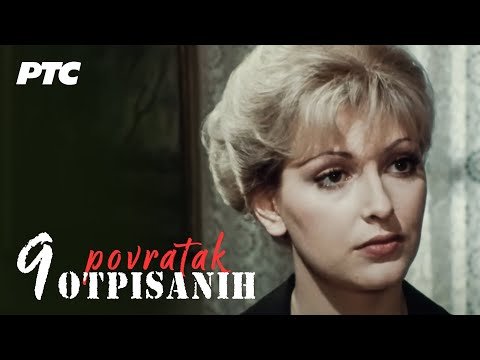
Bekstvo (S01E09)
Airdate: 26 February 1978
Written by: Dragan Marković
Directed by: Aleksandar Đorđević
Running Time: 55 minutes
The times of transition, when the old world is crumbling and the new one has yet to be established, possess an enormous dramatic potential; the uncertainty, the moral quandaries, and the raw human stakes of such moments are the very stuff of compelling narrative. Yet, it appears that someone forgot to convey this to the creators of Povratak otpisanih (The Return of the Written-Off), for the period it depicts – the actual eve of Belgrade’s liberation in the autumn of 1944 – has resulted in some of the weakest episodes of the celebrated Yugoslav series. The ninth instalment, Bekstvo (Escape), stands as a prime example of this squandered potential. While competently crafted on a technical level, it is an episode hamstrung by a lack of narrative focus, a frustrating vignette structure, and a failure to capitalise on the inherent tension of its historical setting.
Bekstvo directly follows the events of Zlato, which dealt with the German evacuation of gold and other valuables. Here, the focus shifts to the evacuation of the Serbian collaborationist administration itself. The narrative thread that follows involves the leadership and staff of the Special Police, with its head, Krsta Mišić, ordering the evacuation of its archive – a prize the Partisans are desperate to obtain. The key to accessing this information remains Marija, still embedded as secretary to the collaborationist city administrator Bešević. Bešević has noted Major Krieger’s infatuation with Marija, evidenced by his gift of jewels confiscated from Jewish citizens. Bešević, himself infatuated, attempts to outdo his rival by offering her something more valuable: a pass and ticket on a train to Vienna. Marija plays along but promptly hands the pass to her comrades. They use it to place Visoki (played by Stevan Štukelja), a Partisan intelligence officer, on the train, tasked with monitoring the collaborationists in exile. Concurrently, a lorry transporting the archive to the station is intercepted and commandeered by Prle with assistance from Cane Kurbla. Prle later delivers the contents to his comrades and ends the episode walking into the night, a typically laconic denouement.
On the surface, Bekstvo is a well-acted and well-directed episode. The performances, particularly from the established cast, retain their credibility, and the direction by Aleksandar Đorđević is professionally assured. However, the episode suffers acutely from a lack of dramatic focus. The central action set-piece – the hijacking of the archive lorry – should be the narrative highlight, providing a burst of tension and excitement. Instead, it feels like a perfunctory afterthought, a rather banal and darkly humorous affair. Prle and his comrades encounter minimal resistance, easily convincing the Special Police agent Ilija and a single gendarme to surrender. The scene lacks the grit, ingenuity, or suspense that characterised earlier operations in the series, resolving itself with an ease that undermines the supposed value of the prize.
The material preceding this anticlimax possesses some genuine potential, but the script is crippled by a vignette-like structure that leaves multiple storylines dangling, their dramatic potential unfulfilled. A prime example is the subplot involving Bešević being stood up at the central railway station by Marija, with another individual using the precious pass. The elements – a valuable travel document, a jilted man at a transport hub, wartime desperation – are hardcore cinephiles would instantly recognise as inspired by Casablanca. Yet, director Đorđević fails to harness the romantic despair or cynical grandeur of that classic. The moment passes without the required emotional or thematic weight, becoming merely a plot beat rather than a poignant commentary on loss and betrayal in a collapsing world.
The episode also introduces Ana, played by Milka Gazikalović, Marija’s older sister. Ana is deeply ashamed by what she perceives as her sister’s collaboration and offers her a path to redemption by arranging her defection to the Partisans, unaware that Marija is already a deep-cover agent. This setup is ripe for melodrama – the conflict between familial love, perceived shame, and secret loyalty. However, the script deliberately diffuses this tension through humour, primarily via the interactions of Joca, who poses as Marija’s handyman, and Prle, who impersonates a Special Police colleague. Prle takes his role so seriously he begins to flirt with Ana, requiring a reminder that she is a married mother. While these moments provide levity, they also sidestep the more profound emotional confrontation the situation promises, opting for sitcom-like banter over substantive character development.
Aware, perhaps, that the episode requires more conventional action, Đorđević introduces an additional storyline concerning the closure of the Banjica concentration camp. The matter is discussed in a scene between Bešević and Major Krieger; prisoners are divided into three groups: those to be executed, those to be deported to Germany, and those to be released – the latter group being targeted by Chetnik death squads. Party leader Stana instructs Tihi to save as many from this third group as possible. This leads to an encounter where Prle, posing as a target, turns the tables on his would-be executioners. The confrontation between Prle and the cynical killer Boško (Ranko Gučevac) is a triumph of the series’ signature dark humour, with Boško’s sarcastic exchanges providing a grim chuckle. Yet, this storyline’s potential is wasted through unoriginality. It essentially recycles the plot of the very first episode, Povratak, wherein resistance activists were hunted. Furthermore, the depiction stretches credulity: the death squad operates in broad daylight wearing full Chetnik uniforms and insignia, a conspicuous lack of discretion for what should be a covert, deniable operation. This undermines the historical texture the series often strives for.
Where Bekstvo functions more effectively is as exposition, setting the stage for the series’ finale. It serves as an episode of departures and lingering farewells. Regular and semi-regular characters begin their exit: Krsta Mišić is notably baffled by the prospect of German defeat, a small character beat that speaks to the insulated worldview of the regime’s enforcers. In a telling scene, Colonel Müller informs General von Friedrichs that Major Krieger will not leave Belgrade, citing “honour” – a nod to the doomed, anachronistic ethos that still motivates some characters even as their world disintegrates.
Perhaps the most historically resonant moment comes in the scene depicting the final session of the collaborationist cabinet. The scene features Janez Vrhovec reprising his role as the transportation minister from Pečurke, an episode of the predecessor series Otpisani, a nice piece of continuity for dedicated viewers. More intriguing is the character of Minister Rakić, played with oleaginous conviction by Mavid Popović. Unlike his despondent colleagues, Rakić believes their flight will be temporary, positing that the alliance between the Western Allies and the Soviets will inevitably fracture, allowing them to return. This scene does crucial work, anchoring Povratak otpisanih in its precise historical moment while simultaneously serving as a darkly cynical prophecy. Following the collapse of Communist Yugoslavia in the 1990s, Serbia, like much of Eastern Europe, underwent a profound and often painful re-evaluation of its history. The Second World War, once presented through the monolithic lens of Partisan victory, became contested ground. In a grim fulfilment of Rakić’s fictional hope, there have been concerted efforts in certain quarters to rehabilitate and justify the losing side, with figures from Milan Nedić’s collaborationist government being recast by some as misunderstood patriots or national saviours. The episode, perhaps unintentionally, captures the embryonic form of this future historical revisionism, adding a layer of tragic irony for contemporary audiences aware of the post-Yugoslav debates.
In the end, Bekstvo is an episode caught between functions. It is neither a satisfying, self-contained adventure nor a purely efficient narrative bridge. Its strengths – capable performances, moments of effective humour, and interesting historical detail – are offset by a scattered plot, unresolved vignettes, and action sequences that lack punch. It exemplifies how the rich dramatic soil of October 1944 Belgrade yielded, in this case, a curiously underwhelming harvest. The episode manages to set the table for the concluding acts but does so with less skill and focus than one might expect from a series of such pedigree.
RATING: 6/10 (++)
Blog in Croatian https://draxblog.com
Blog in English https://draxreview.wordpress.com/
InLeo blog https://inleo.io/@drax.leo
LeoDex: https://leodex.io/?ref=drax
InLeo: https://inleo.io/signup?referral=drax.leo
Hiveonboard: https://hiveonboard.com?ref=drax
Rising Star game: https://www.risingstargame.com?referrer=drax
1Inch: https://1inch.exchange/#/r/0x83823d8CCB74F828148258BB4457642124b1328e
BTC donations: 1EWxiMiP6iiG9rger3NuUSd6HByaxQWafG
ETH donations: 0xB305F144323b99e6f8b1d66f5D7DE78B498C32A7
BCH donations: qpvxw0jax79lhmvlgcldkzpqanf03r9cjv8y6gtmk9