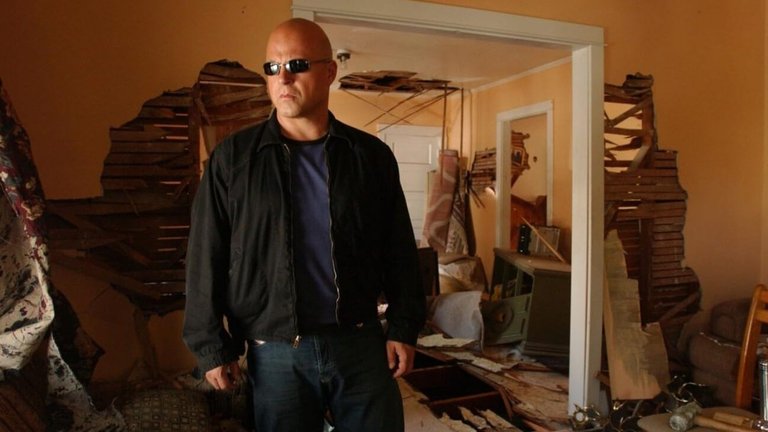
Open Tilt (S03E15)
Airdate: June 15th 2004
Written by: Shawn Ryan & Glen Mazzara
Directed by: Scott Brazil
Running Time: 45 minutes
Season finales, particularly within the tense, serialised framework of a show like The Shield, traditionally bear a heavy burden. They are expected to be the most consequential, explosive, and memorable episodes of a run, performing the double duty of tying up sprawling multi-episode arcs while simultaneously delivering a major cliffhanger to grip the audience through the hiatus. Open Tilt, the concluding chapter of the show’s third season, succeeds in its narrative mechanics, yet it does so not with the series’ characteristic, gut-punching bang, but with something closer to a proverbial whimper. It is a competent, often very good episode, but when held against the seismic conclusions of the first two seasons, it feels more like a grim, obligatory sigh of exhaustion than a defining event. It resolves the immediate threats while meticulously arranging the dominoes for future collapse, but lacks the visceral, shocking physicality that had become the show’s finale signature.
The entire season’s main storyline was, by design, an exercise in grim consequence. It dealt with the aftermath of the previous season’s spectacular finale: the Strike Team’s successful execution of Vic Mackey’s plan to rob the Armenian mob’s ‘money train’. Far from providing a long-term solution, however, the mountain of stolen cash has cast an ever-lengthening and darkening shadow over their careers, lives, and, most crucially, their brotherhood. Unable to spend their ill-gotten gains without attracting scrutiny, Vic, Shane, Lem, and Ronnie spent fourteen episodes in a state of paranoid tension, attempting to misdirect both vengeful Armenian mobsters and determined federal agencies. This financial paralysis, coupled with the moral weight of their actions—which resulted in the deaths of innocent civilians—proved corrosive. Their failure to maintain discipline ignited deep and seemingly irreversible fissures within the Strike Team itself, transforming allies into wary, resentful accomplices.
These divisions erupted violently at the end of the preceding episode, All In. Lem, the team’s moral centre and the member most visibly haunted by the collateral damage, attempted a symbolic act of purgation: burning the ‘blood money’ in a furnace. Though his teammates stopped him, Open Tilt reveals that most of the stash was indeed reduced to ashes. This leaves Vic, Shane, and Ronnie with only a pittance, forcing Vic into a desperate recalculation of his entire financial future. He must also contend with an Armenian mob still thirsting for vengeance and unaware their capital is gone, and, most pressingly, with Lem, whose continued presence on the team now seems untenable. Vic’s response is pragmatic, yet stripped of any sentimental warmth. He allows Lem back, but only under the proviso that once the Armenian situation is resolved, Lem will transfer out. This calculus is immediately complicated by Captain Aceveda, who informs Vic that Chief Bankston, seeking to burnish the department’s image, has decided to phase out the Strike Team and similar units. A replacement for Lem, therefore, is unlikely, threatening the team’s very existence.
A potential reprieve emerges from within the enemy camp. Goma Magar (Michael Benayer), a lieutenant to crime lord Margos Dezarian, approaches Vic with an offer: a truce in exchange for the Strike Team providing security for a major heroin shipment. Vic, ever the manipulator, turns the tables. Using information coerced from Magar’s subordinates and his informant, Ayla, he locates and leads a raid on a massive heroin stash. In a brilliantly cynical move, Vic then presents Magar to the Armenian crew as the informant, leaving him with no choice but to cooperate fully. Magar reveals Dezarian’s hideout. Recognising that Dezarian alive is a perpetual threat, Vic arrives first and, in a cold-blooded execution, shoots the crime lord. With Dezarian eliminated, the immediate pressure on the Strike Team momentarily dissipates, allowing a shallow breath of relief.
Yet, the future remains bleak. At a meeting meant to chart a path forward, the simmering tensions boil over. Lem, physically ill from the psychological ordeal, is asked to stay, but the gathering quickly disintegrates. First, Lem and Shane trade vicious accusations, culminating in Lem’s furious departure. Then, the conflict turns inward, between Vic and his protégé. They blame each other for the chaos engulfing them, their argument laying bare the shattered trust. Shane storms out, leaving a tearful Vic alone, starkly aware that the edifice he built—his team, his authority, his years-long friendship—lies in ruins around him. It is a powerful, emotionally raw conclusion, but its impact is one of tragic inevitability rather than shock.
A parallel storyline follows Detective Claudette Wyms’ dogged, ethically fraught crusade. She investigates cases handled by Lisa Kensit, a critically injured public defender revealed to have been a long-term drug addict. Claudette becomes convinced that some of Kensit’s clients were wrongly convicted due to her impaired state. The prime candidate is Walter Clifton (Ray Stonery), a career robber incarcerated based on testimony Claudette and a reluctant Dutch prove to be false. Her mission, which could potentially flood the streets with released convicts, is deeply unpopular within the Barn. When she confronts Aceveda and Assistant DA Rommi Cohen (Cari Golden) with her findings, she is met with institutional resistance and a blunt, career-limiting prophecy from Aceveda: she will never make captain. Her subplot serves as a counterpoint to the Strike Team’s chaotic corruption, presenting a different kind of struggle—one for integrity within a system often hostile to it.
A minor, poignant side narrative involves Robert Huggins (Andre Benjamin), a comic book store owner driven to vigilante action by the prostitutes and dealers plaguing his street. His method—hosing them down and filming them—is an absurd yet understandable display of civic frustration. Officer Julien Lowe admires his spirit but is resigned to the futility of the effort, knowing that any police action would simply displace the problem to another block. This vignette reinforces the season’s overarching theme: individual actions, whether noble, criminal, or desperate, are often mere rearrangements of chaos within an immutable ecosystem of decay.
Co-written by series creator Shawn Ryan and Glen Mazzara, and directed by the dependable Scott Brazil, Open Tilt is a well-constructed episode. However, it occasionally falls below the series’ own high standards. The lack of visceral impact is notable in the sequence following the heroin bust. As the record haul is displayed, every officer present breaks into spontaneous applause—a moment of unadulterated triumph. Vic, however, burdened by his myriad deceptions and the crumbling of his team, stands detached and unemotional. While this dissonance is intentional, highlighting his isolation, the scene’s placement in the mid-act and its execution lack the profound, ironic punch such a moment deserved. It feels procedural rather than profoundly thematic.
Characterisation also shows some unevenness. The darkly humorous subplot involving Dutch being saddled with a stray kitten feels like a cheap, tonally jarring attempt to inject ‘quirk’ into the episode. It risks reducing the complex, nerdy, yet profoundly competent detective into a potential caricature, an unwelcome hint of a Hannibal Lecter in the making that the series never needed. Similarly problematic is the scene with Ayla. Upon learning Vic has killed Dezarian, avenging her sister, she offers him sex as gratitude. Vic initially refuses but succumbs, only for the encounter to degenerate into her sobs. While arguably realistic and decidedly un-erotic, the scene feels unnecessary, a clumsy effort to assert that Vic’s traditional masculinity and reputation as a ladies’ man remain intact amidst his personal ruin. It adds little to his character development that previous episodes had not already established with more nuance.
Conversely, the episode introduces a subtle and intriguing ambiguity regarding Captain Aceveda. Previously portrayed as a devout family man, he is seen subtly testing the boundaries of his own morality. He removes his wedding ring before a meeting with Assistant DA Cohen, who subsequently flirts with him. Later, he picks up a street prostitute, only to tell her to move her business elsewhere—ostensibly to aid Huggins’ cause, but leaving the audience to question his initial, unspoken intentions. This faint crack in his moral armour is a masterful piece of character shading, suggesting the corrupting atmosphere of the Barn spares no one.
At the end of the day, Open Tilt is an episode of efficient, often powerful, table-setting. It resolves the immediate Armenian threat with Vic’s characteristically ruthless efficiency and delivers the emotionally devastating, albeit predictable, dissolution of the Strike Team’s core bond. However, compared to the landmark finales that preceded it, it lacks a certain transformative electricity. Its victories feel pyrrhic and empty, its emotional blows expected rather than astonishing. It is, ultimately, very good television that nonetheless feels like a step back from the show’s own pioneering greatness.
RATING: 7/10 (+++)
Blog in Croatian https://draxblog.com
Blog in English https://draxreview.wordpress.com/
InLeo blog https://inleo.io/@drax.leo
InLeo: https://inleo.io/signup?referral=drax.leo
Leodex: https://leodex.io/?ref=drax
Hiveonboard: https://hiveonboard.com?ref=drax
Rising Star game: https://www.risingstargame.com?referrer=drax
1Inch: https://1inch.exchange/#/r/0x83823d8CCB74F828148258BB4457642124b1328e
BTC donations: 1EWxiMiP6iiG9rger3NuUSd6HByaxQWafG
ETH donations: 0xB305F144323b99e6f8b1d66f5D7DE78B498C32A7
BCH donations: qpvxw0jax79lhmvlgcldkzpqanf03r9cjv8y6gtmk9