The Summer Man (S4x08)
Airdate: 12 September 2010
Written by: Lisa Albert, Janet Leahy and Matthew Weiner
Directed by: Phil Abraham
Running Time: 48 minutes
By the midpoint of its fourth season, Mad Men creator Matthew Weiner appeared to have become acutely aware that his acclaimed series risked settling into a comfortable, formulaic rhythm. The show had established its visual language, its deliberate pacing, and its signature method of conveying character through implication rather than explicit statement. Yet the mid-1960s were, culturally and historically, a period of radical upheaval and experimentation, and Weiner seemed to recognise that his characters—and the show itself—needed to evolve in kind. The result of this creative restlessness can be seen in episodes like The Summer Man, an instalment that deliberately breaks with the series’ established conventions in ways that remain, to this day, both fascinating and divisive among its audience.
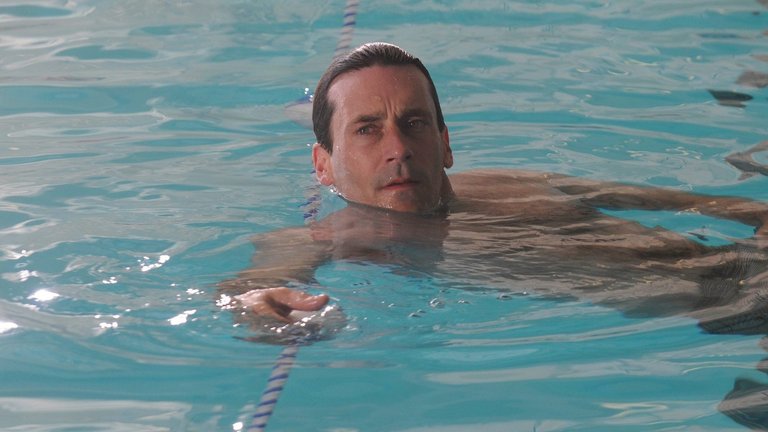
The episode takes place roughly a month after the event that left Don Draper utterly devastated: the death of Anna Draper, the only person who truly knew and accepted him for who he was. The ensuing, alcohol-fuelled spiral brought Don to such a profound nadir that even he could no longer ignore the destructiveness of his behaviour. In a bid to turn his life around, he identifies his most obvious problem—excessive drinking—and attempts to cut down. To find both the physical and psychological tools for this effort, Don joins the New York Athletic Club and spends increasing amounts of time swimming laps in the pool, an activity he finds genuinely beneficial to his wellbeing. More significantly, he begins to record his thoughts in a journal, a practice brought directly to the audience through Jon Hamm’s narration.
The narrative is anchored around 21 June 1965, the second birthday of Don’s youngest son, Gene. The occasion forces Don to confront the reality of his lost family. Betty and her new husband, Henry Francis, have made it abundantly plain that they do not want him present at the celebration. For Betty, Don has become an unpleasant ghost of the past, a reminder of a marriage she has worked hard to bury. Henry, attempting to advance his political connections, takes Betty to a posh New York restaurant to meet Ralph Stuben (Peter Lewis), an aide to the young and ambitious Republican congressman John Lindsay, who is about to run for mayor of New York. Stuben is angling for the support of Henry’s employer, Governor Nelson Rockefeller, for an even more ambitious aim: a presidential run tentatively planned for 1972. Yet the political machinations take a back seat when Betty stumbles upon Don in the company of Bethany Van Nuys, a younger and more glamorous version of herself. Betty is visibly shaken by the encounter and spends much of the evening sulking in the ladies’ room, leaving Henry embarrassed and furious. When they return home, Henry’s anger is such that he begins to openly question whether marrying Betty was the right decision. The evening ends far more pleasantly for Don, who, while riding home in a taxi, receives fellatio from Bethany, accompanied by the memorable words: “To be continued.”
Another act of fellatio—albeit not a real one—causes a minor disruption in the offices of Sterling Cooper Draper Pryce. The young creative staff are frustrated with a broken vending machine that keeps eating their money. This frustration leads Joey Baird to deride Joan Holloway, who, as office manager, sits considerably higher in the office hierarchy. Joey’s remarks are crudely sexist and wound Joan deeply, particularly as she is already emotionally vulnerable: her husband Greg is about to enter basic training and may well be sent to fight in Vietnam. When Joan attempts to chide Joey, he not only ignores her but, drawing on office gossip that Joan and Lane Pryce are an item, produces a crude cartoon depicting Joan performing fellatio on Lane and hangs it near her office wall.
This time, Peggy Olson decides that her colleagues and subordinates have gone too far. She goes to Don to complain, but he tells her that if she wants respect, she must make the unpleasant personnel decision herself. Peggy summons Joey to her office and, much to his shock, fires him on the spot. However, Joan, instead of thanking Peggy for standing up for her, chides her. In Joan’s experience, the popularity and office standing of both women will suffer as a result of this confrontation.
Meanwhile, Don overhears Dr. Faye Miller on the telephone breaking up with her boyfriend. Seeing an opportunity, he makes his move, and she—much to his surprise—agrees to a dinner date. The evening goes well, and Faye is clearly open to spending the night together, but at the last moment Don declines her offer. Instead, the episode concludes with Don crashing Gene’s birthday party and enjoying a brief, bittersweet moment with his son, while Betty physically stops Henry from interfering.
The Summer Man is notable as the only episode of Mad Men to employ a character’s voiceover narration. This proved to be a controversial decision, at least among a section of critics who considered it a betrayal of the series’ subtle approach and its adherence to the principle of “show, don’t tell.” Nevertheless, the device works surprisingly well, offering us minor but valuable insights into Don’s inner thoughts and his background—particularly when he complains that he struggles to write down his thoughts because he never actually finished high school. The script, co-written by Weiner, Lisa Albert, and Janet Leahy, cleverly juxtaposes the motif of summer and rejuvenation with the protagonist’s attempt to turn his life around. Don feels refreshed after swimming and is delighted to see young, happy people on the streets, while the Rolling Stones’ “(I Can’t Get No) Satisfaction” serves as the musical cue for this change in perspective.
The juxtaposition between Don rising from rock bottom while Betty and Henry hit a rough patch in their marriage is particularly clever, suggesting that happiness and misery are not zero-sum but rather coexist in unpredictable patterns. Bethany Van Nuys’s line, “To be continued,” works beautifully as an ironic meta-commentary, given that the character effectively disappeared from the rest of the series—though whether this was Weiner’s intention or simply an accident of storytelling remains uncertain.
In the end, The Summer Man, despite its technical oddities, works remarkably well as an episode. It looks as though Matthew Weiner, just like his protagonist, managed to reclaim some of his creative mojo at a moment when the series risked losing its way. The experiment with voiceover narration may divide opinion, but it serves the story it is trying to tell, and that, ultimately, is what matters most.
RATING: 7/10 (+++)
==
Blog in Croatian https://draxblog.com
Blog in English https://draxreview.wordpress.com/
InLeo blog https://inleo.io/@drax.leo
Substack https://draxster.substack.com/
LeoDex: https://leodex.io/?ref=drax
InLeo: https://inleo.io/signup?referral=drax.leo
Hiveonboard: https://hiveonboard.com?ref=drax
1Inch: https://1inch.exchange/#/r/0x83823d8CCB74F828148258BB4457642124b1328e
BTC donations: 1EWxiMiP6iiG9rger3NuUSd6HByaxQWafG
ETH donations: 0xB305F144323b99e6f8b1d66f5D7DE78B498C32A7
BCH donations: qpvxw0jax79lhmvlgcldkzpqanf03r9cjv8y6gtmk9