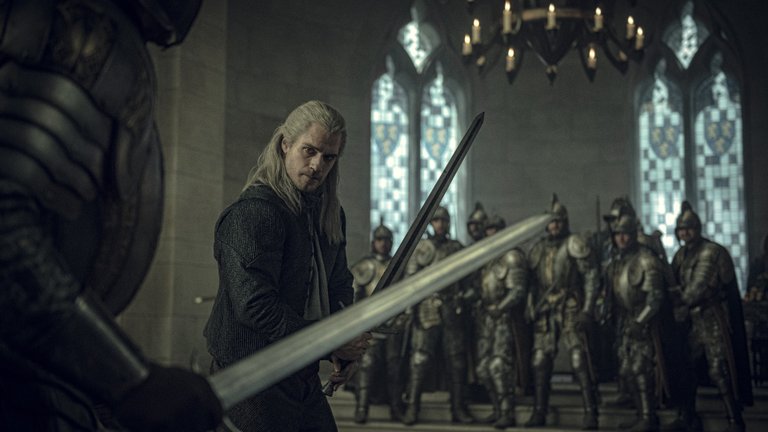
In the distant year of 2019, in happier times unburdened by global health and macroeconomic disruptions, for not so small a number of people the question of all questions was what would be the next Game of Thrones after Game of Thrones. Numerous TV networks had been trying to find the answer even before the saga ended, including HBO, for whom precisely that globally epic fantasy series was a golden goose, and whose attempt with Westworld ended unsuccesfully. HBO's most dangerous rival – the streaming giant Netflix – also joined the competition, attempting to compensate for any quality shortcomings with quantity – through furious churning out of new series. Perhaps precisely because of the sea of new Netflix titles, a project that most closely matches the parameters of Game of Thrones in terms of content and theme remained outside the expected attention – namely, a screen adaptation of a globally popular cycle of books in the epic fantasy genre. This is about the TV series The Witcher, based on the stories and novels by Polish writer Andrzej Sapkowski.
Sapkowski published the first story from the cycle in 1986, establishing himself as not only a gifted writer but also a capable entrepreneur, who served the audience, primarily the domestic one, with stories and characters that add infusions of Slavic mythology to the Tolkien-esque world of swords, sorcerers and elves, but also "spicier" content involving explicit violence and sex, as well as morally ambiguous characters of the sort that Game of Thrones would later accustom us to. Sapkowski gained such popularity that as early as 2001 his work was first adapted for the screen as, albeit short-lived, Polish TV series Wiedźmin (distributed in English-speaking territories under the title The Hexer). However, it gained international fame only in 2007 thanks to the video game The Witcher, which reached three fairly acclaimed sequels. Therefore, the announcement that Netflix would undertake an adaptation sparked interest, but still not the kind one might expect from a project that should be the new Game of Thrones.
The title character, played by Henry Cavill, is Geralt of Rivia, a witcher who lives on an unnamed Continent that humans settled some five hundred years ago, having defeated the previously dominant elves and dwarves, who were forced to live in remote forests and mountains, or as an oppressed minority in human cities and settlements. However, on the Continent, besides these ancient creatures, one can also find various rather unpleasant forms of supernatural fauna, including monsters that only witchers can defeat. Geralt, who is himself partly of elven descent, is considered the best monster hunter, but is motivated primarily by money, and carries out his services quickly, efficiently and without too much agonising over ethics or concern for matters he thinks don't concern him. This includes the shadows of war looming over the Continent, primarily the Nifgaardian Empire's efforts to subjugate the Northern Kingdoms, and in which, for their own reasons, sorcerers organised in a guild that includes Yennefer of Vengeberg (Anya Chalotra) have also become entangled, and who will embark on a passionate love affair with Geralt. Geralt ultimately becomes further entangled in the war when it turns out that one of the Nifgaardian targets is Princess Cirilla of Cintra (Freya Allan), with whom he is literally fatefully bound, and who flees from the enemy into the elven forests.
At first glance, Netflix's series has taken quite a lot from Game of Thrones. Besides the genre content, there's the season format of just eight one-hour episodes, as well as the engagement of acclaimed director Alik Sakharov. However, the internal structure of the season is significantly different, which is a consequence of the producers' decision to base the season less on the video games that are far better known to the wider public and more on the original literary source. Namely, before the novels, Sapkowski published short story collections – The Last Wish and Sword of Destiny – which serve as a kind of introduction to Geralt's world and on which the first season is based. The plot of the eight episodes is largely based on stories that are standalone adventures and have an episodic character, onto which the main plotline is only subsequently connected, presented through the currently fashionable non-linear narration. Viewers will thus at times be confused and will need time to pick up all the threads, and only towards the end will things start falling into place.
The series is technically satisfactory, but could hardly be called impressive, at least compared to Game of Thrones, which showcased magnificent cities and epic battles. The reason can partly be found in the budget, but also in the effort to be as different as possible from the HBO series. Therefore, a large part of the action takes place in dark interiors, or seemingly prosaic forests, mountains and caves. On the other hand, the cast is more than solid. Special praise should go to Henry Cavill, for whom the role of a cynical anti-hero suits far better than the superhero role of Superman. Anya Chalotra is also very good in a rather demanding role that required her to transform from an ugly duckling into an irresistible seductress. A rather pleasant surprise is also Joel Baty in the role of the travelling bard Jaskier, whose vocal abilities served well for the song "Toss a Coin to Your Witcher", which managed to become a hit close to "The Rains of Castamere". The casting, on the other hand, is in some cases a disappointment, at least when it comes to fans of the video games; thus the sorceress Triss Merigold, whose sex symbol status was confirmed by the cover of the Polish edition of Playboy, here arrived in the incarnation of the not particularly glamorous Anna Shaffer.
Although the first season of The Witcher, which ends with the usual irritating cliffhanger, is unlikely to leave the average viewer open-mouthed, it will mostly satisfy those who could have assumed that the bar set by Game of Thrones is hard to reach on the first attempt. On the other hand, it has laid an exceptionally high-quality foundation on which, with a little more creative and other resources, similarly to the case with the video games, something truly special can be built.
RATING: 7/10 (+++)
(Note: The text in the original Croatian version is available here.)
Blog in Croatian https://draxblog.com
Blog in English https://draxreview.wordpress.com/
InLeo blog https://inleo.io/@drax.leo
LeoDex: https://leodex.io/?ref=drax
Hiveonboard: https://hiveonboard.com?ref=drax
InLeo: https://inleo.io/signup?referral=drax.leo
Rising Star game: https://www.risingstargame.com?referrer=drax
1Inch: https://1inch.exchange/#/r/0x83823d8CCB74F828148258BB4457642124b1328e
BTC donations: 1EWxiMiP6iiG9rger3NuUSd6HByaxQWafG
ETH donations: 0xB305F144323b99e6f8b1d66f5D7DE78B498C32A7
BCH donations: qpvxw0jax79lhmvlgcldkzpqanf03r9cjv8y6gtmk9