Few movies have captured the soul-crushing absurdity of modern office life better than Office Space. Released in 1999, it bombed in theaters but slowly became one of the biggest cult classics of its era. Anyone who’s ever sat in a cubicle, dealt with pointless memos, or answered to a manager who shouldn’t even be managing a stapler knows exactly why this film still hits so hard. It’s funny, it’s oddly comforting, and it’s one of those rare movies that gets more relatable every year.
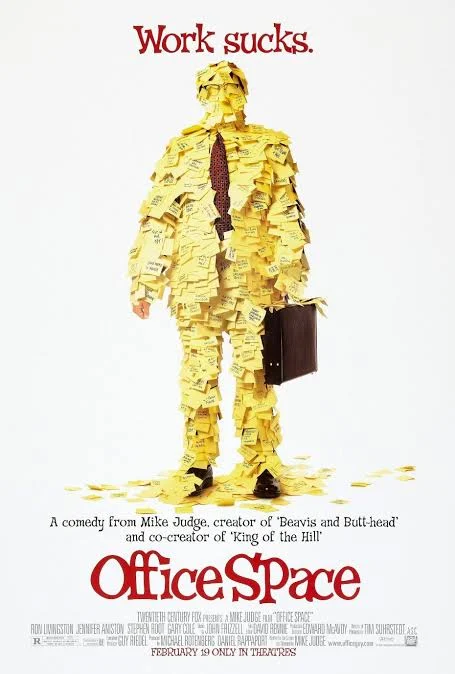 (All images taken directly from film Office Space) (All text my own original blog and thoughts)
The plot centers on Peter Gibbons, a burned-out software employee at a company called Initech. He’s stuck in that corporate loop where nothing matters, everything’s inefficient, and no one has a clue what they’re doing. After a hypnotherapy session goes wrong, he suddenly stops caring — and ironically becomes the most productive and admired worker in the office. That’s the magic of the film: it exposes how ridiculous corporate culture is by showing how success often has nothing to do with competence or effort.

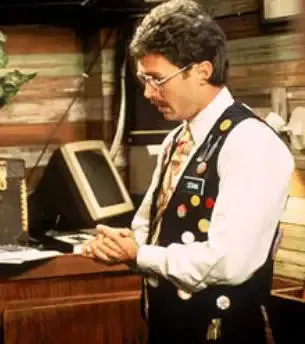
The cast is a big part of why the movie works. Ron Livingston nails the tone as Peter: bored, frustrated, and quietly rebellious. Jennifer Aniston plays Joanna, the restaurant worker who is dealing with her own brand of customer-service hell. And then there’s Gary Cole as Bill Lumbergh, the passive-aggressive manager who can ruin your entire week with one slow, nasal “Yeahhh… I’m gonna need you to come in on Saturday.” Stephen Root absolutely steals scenes as Milton, the mumbling office ghost who just wants his red Swingline stapler back.

What really gives Office Space its personality is the soundtrack. Instead of going the typical quirky comedy route, the movie went full 90s gangsta rap — and it was the perfect choice. Tracks from Ice Cube, Scarface, Geto Boys, and others add this hilarious contrast between the dullness of office work and the fantasy of rebellion brewing inside every frustrated employee. “Damn It Feels Good to Be a Gangsta” basically became a cultural shorthand for office rebellion because of this movie.
Of course, no discussion about Office Space is complete without mentioning the printer scene. Watching Peter, Michael Bolton, and Samir drag that malfunctioning printer into a field and beat it senseless is still one of the most cathartic moments in film history. Anyone who’s dealt with a jammed copier or a broken corporate system knows exactly what that scene represents. It’s violent, ridiculous, and somehow therapeutic.

The movie also digs into something deeper beneath the jokes: the way corporations treat people like replaceable parts. Whether it’s endless TPS reports, pointless meetings, or managers who reward obedience instead of talent, the film highlights how dehumanizing the system can be. And the irony is, nothing has changed since 1999. If anything, office culture has gotten worse more metrics, more surveillance, more bureaucracy. That’s why Office Space still feels brand new.

In the end, the film isn’t about overthrowing the system so much as escaping it. Peter’s journey from miserable employee to someone who just wants a simple, honest life builds the story’s charm. It’s a reminder that happiness isn’t found in cubicles, titles, or corporate ladders as it’s found in actually living your life.

More than twenty years later, Office Space remains one of the most accurate comedies ever made about work. It’s funny, sharp, brutally honest, and timeless. Anyone who’s ever sat under fluorescent lights knows exactly why this movie endures. It’s less a film and more a therapy session disguised as a comedy.