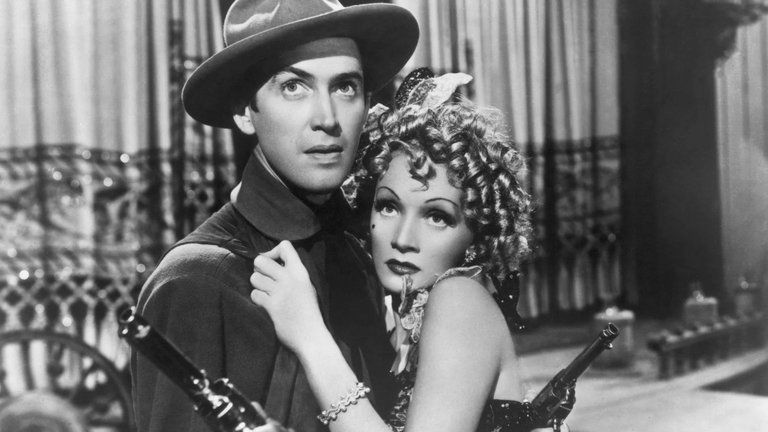
The year 1939 is frequently cited as the annus mirabilis of Classic Hollywood, a golden period so densely packed with masterpieces that they must inevitably be separated into distinct tiers. While the upper echelons are occupied by such undisputed, monumental works as Gone with the Wind, The Wizard of Oz, and Stagecoach, the lower tier is no less fascinating, housing pictures that achieved iconic status through sheer star power and entertainment value rather than pure cinematic innovation. George Marshall’s Destry Rides Again, a Western comedy that provided one of the era’s greatest stars with her most iconic sound-era role while simultaneously catapulting another to new heights, firmly belongs to this latter category. It is a film of considerable charm and professional polish, yet one whose legacy is perhaps more significant than its intrinsic artistic merit, being a fascinating product of studio system pragmatism, genre hybridisation, and the potent alchemy of its leading players.
The opening credits offer an immediate clue to the film’s derivative yet opportunistic nature, noting it was merely “suggested by” Max Brand’s 1930 novel. This was a conveniently vague formulation, a common Hollywood practice to explain that the plot has, in fact, very little to do with its purported source material. The novel had already been adapted more faithfully in a 1932 Tom Mix vehicle. This 1939 version effectively jettisons the original narrative, transplanting its essence into the fictional, aptly named town of Bottleneck. Here, a classic scenario of corruption unfolds: the town is ruled by the ruthless saloon owner Kent (Brian Donlevy), who employs his girlfriend, the chanteuse Frenchy (Marlene Dietrich), to distract and fleece men at the poker tables. When a rancher, Lem Claggett (Tom Fadden), is cheated out of his property and the investigating Sheriff Keogh (Joe King) is murdered, the corrupt mayor (Samuel S. Hinds) appoints the town drunk, Washington “Wash” Dimmsdale (Charles Winninger), as the new sheriff. Wash, a former deputy to the legendary lawman Tom Destry, sobers up and summons his old boss’s son, Thomas Destry Jr. (James Stewart). The central conceit—and the film’s primary comic engine—is that Destry Jr., despite his formidable familial reputation, is a resolute pacifist who refuses to carry a gun. His methodical, unarmed intelligence as he ascertains the situation and prepares for an inevitable showdown provides the narrative spine, around which entwines a subplot of Frenchy’s growing, reluctant attraction to the morally upright newcomer.
Directed by the prolific George Marshall, whose career spanned five decades of Hollywood history, Destry Rides Again exhibits the superb production qualities typical of a major studio release at its peak. These technical virtues—crisp cinematography, sturdy sets, and efficient pacing—help the film overcome its fundamental generic limitations. Its identity is notably split. As a Western, its action is curiously stage-bound, largely confined to the saloon and the main street of Bottleneck, giving it the air of a theatrical play rather than an expansive frontier epic. It feels slight when compared to the mythic grandeur of Stagecoach, released the same year. The film functions far more effectively as a comedy, leveraging Stewart’s innate likability and a roster of eccentric townsfolk. Yet, this comedic tone exists in an uneasy, sometimes jarring, juxtaposition with genuinely dark content: multiple murders, systemic corruption, and the lingering shadow of Destry Sr.’s violent death, which serves as a sobering reminder of the cost of law enforcement.
Where the film truly excels is in its exploitation of star power. For Marlene Dietrich, then languishing under the label of “box office poison,” Frenchy was a career-reviving godsend. She returned with gusto to the archetype of the worldly, morally ambiguous entertainer, a persona she had perfected earlier in the decade. While her musical numbers, including “The Boys in the Back Room,” lack the transcendent, avant-garde edge of her collaborations with Josef von Sternberg, they are delivered with a knowing, weary sensuality that perfectly defines the character. For James Stewart, then a rising star known for his earnest, everyman qualities, this role marked his first foray into the Western genre. He cleverly transposed his trademark “aw-shucks” persona onto the archetypal Western hero, creating a uniquely pacifist lawman whose strength derives from wit and moral certainty rather than firearms. The off-screen torrid affair between Stewart and Dietrich, much reported by gossip columnists of the time, adds a layer of palpable, off-kilter chemistry to their on-screen interactions, where Frenchy’s cynical world-weariness clashes delightfully with Destry’s naive integrity.
The film is further elevated by an exceptional supporting cast, who breathe life into archetypes with remarkable skill. Mischa Auer provides superb comic relief as Boris Stavrogin, a Russian immigrant whose tragicomic loss of his trousers to Frenchy in a poker game becomes a running gag. Una Merkel, one of Classic Hollywood’s most underrated talents, is magnificent as the domineering, moralistic Lilly Belle. Her legendary catfight with Dietrich’s Frenchy remains one of the film’s most startling sequences. Reportedly filmed in a single, bruising take with considerable improvisation, the scene is unexpectedly visceral and realistic, a raw burst of physicality that stands in stark contrast to the often-stylised violence of the era. The actresses’ subsequent injuries attested to the scene’s authentic ferocity.
For all its entertainment value, the film is not without structural flaws. The climax, in which Destry finally arms himself and leads a makeshift militia against Kent’s gang, feels somewhat anti-climactic. Despite a flurry of gunplay and the surreal, amusing sight of the town’s women joining the fray, the resolution arrives with a sense of procedural inevitability rather than thrilling catharsis.
A more profound narrative weakness is imposed by the strictures of the MPAA Production Code. Frenchy, as the “bad girl,” cannot be allowed a romantic future with the flawlessly heroic Destry, regardless of their chemistry or her redemptive sacrifice. This forced the script to introduce the character of Janice Tyndall (Irene Hervey), the obligatory “good girl” who represents Destry’s appropriate marital prospect. Hervey does what she can, but the role is irredeemably one-dimensional, making the final romantic alignment feel formulaic and undermining the more complex, bittersweet connection between Destry and Frenchy. Her fate, though dramatically poignant, ultimately serves as a punishment for her earlier transgressive lifestyle, a mandatory concession to moral orthodoxy that dates the film considerably.
Despite these compromises, Destry Rides Again was a resounding commercial success. Its most lasting impact was the dramatic rejuvenation of Dietrich’s career, re-establishing her as a potent and bankable star. The film’s legacy extended beyond its initial release; George Marshall directed a near shot-for-shot remake in 1954, Destry, starring Audie Murphy. More significantly, the film was immortalised through parody in Mel Brooks’s Blazing Saddles (1974), where Madeline Kahn’s brilliant performance as Lilly von Shtupp is a direct and loving homage to Dietrich’s Frenchy, cementing the character’s place in the cultural lexicon.
Destry Rides Again is a film of modest artistic ambition that achieved outsized historical importance. It is not a pioneering Western nor a groundbreaking comedy, but a highly polished, supremely entertaining example of studio craftsmanship. Its enduring appeal lies in the magnetic collision of two iconic stars at pivotal moments in their careers, and in the enduring, scrappy charm of a well-told tale where the good guy wins by outthinking the bullies, all set to the tune of a saloon piano. It is, in essence, a quintessential lower-tier gem of Hollywood’s greatest year—flawed, formulaic in places, yet utterly indispensable.
RATING: 7/10 (+++)
==
Blog in Croatian https://draxblog.com
Blog in English https://draxreview.wordpress.com/
InLeo blog https://inleo.io/@drax.leo
InLeo: https://inleo.io/signup?referral=drax.leo
Leodex: https://leodex.io/?ref=drax
Hiveonboard: https://hiveonboard.com?ref=drax
Rising Star game: https://www.risingstargame.com?referrer=drax
1Inch: https://1inch.exchange/#/r/0x83823d8CCB74F828148258BB4457642124b1328e
BTC donations: 1EWxiMiP6iiG9rger3NuUSd6HByaxQWafG
ETH donations: 0xB305F144323b99e6f8b1d66f5D7DE78B498C32A7
BCH donations: qpvxw0jax79lhmvlgcldkzpqanf03r9cjv8y6gtmk9