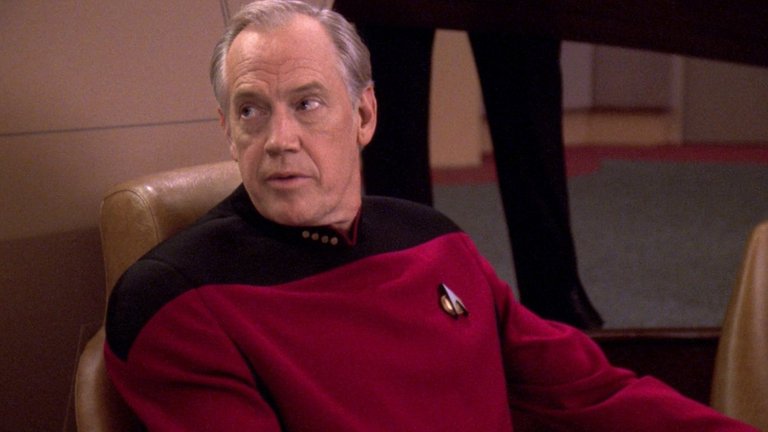
Chain of Command, Pt I (S06E10)
Airdate: 14 December 1992
Written by: Ronald D. Moore
Directed by: Robert Scheerer
Running Time: 46 minutes
At the close of 1991, one distinct era of Star Trek drew to a definitive curtain with Star Trek VI: The Undiscovered Country, the franchise’s poignant farewell to the original series and its iconic cast. Roughly a year later, another era was beginning to stir, as Star Trek: The Next Generation prepared to hand over the narrative baton to its forthcoming sibling, Deep Space Nine. It offered a symbolic prelude with a two‑part episode featuring the alien race that would serve as the principal antagonists of that new series: the Cardassians. That episode was “Chain of Command”. Its first instalment remains a solid piece of television craftsmanship, yet it suffers palpably from an artificial division mandated by production logistics and from its own over‑theatrical, somewhat hackneyed cliffhanger ending.
The episode opens with the USS Enterprise rendezvousing with the USS Cairo near the Cardassian border. Captain Jean‑Luc Picard is summoned to meet Admiral Nina Nechayev (Natalia Nogulich). In a brisk, unceremonious briefing, Nechayev informs Picard that he is to be relieved of command of the Enterprise. His replacement is Captain Edward Jellico (Ronny Cox), who arrives immediately to take the centre seat. The stated rationale is a major Cardassian military build‑up, coupled with their sudden abandonment of the Bajoran sector—circumstances that Starfleet Intelligence interprets as precursors to a possible incursion or a new war. Jellico’s remit is not merely to assess the tactical situation; owing to his prior diplomatic experience with the Cardassians, including having helped draft the treaty that ended the last conflict, he is to handle any negotiations that may arise.
Simultaneously, Picard is chosen to lead a top‑secret covert mission into Cardassian territory itself. The objective: to infiltrate the planet Celtris III and verify the existence of a suspected Cardassian metagenic‑weapon research facility, where scientists are reportedly developing a new delivery system based on theta‑band subspace emissions. Picard is accompanied by Dr. Crusher, to provide essential medical expertise, and Lieutenant Worf, for security. The trio undergo extensive, immersive training in the holodeck, rehearsing every conceivable contingency.
Jellico’s assumption of command does not sit well with the Enterprise crew. He is immediately portrayed as more formal, more rigidly by‑the‑book, and conspicuously lacking in the collegial warmth that defined Picard’s tenure. He shows little enthusiasm for his new subordinates, with the notable exception of Data, whose positronic nature appeals to Jellico’s preference for unambiguous efficiency. Yet, when he consults Counsellor Troi prior to negotiations with the Cardassian representative Gul Lemec (John Durbin), Jellico reveals himself to be acutely perceptive and strategically adept. He pointedly—and famously—insists that Troi wear a standard Starfleet uniform on the bridge rather than her customary civilian attire, a directive that would become permanent for the character henceforth. This moment is more than a costume change; it is a symbolic assertion of military discipline over therapeutic informality, a small but telling illustration of Jellico’s philosophy.
Meanwhile, the covert mission unfolds. Picard, Crusher, and Worf infiltrate Celtris III with the aid of a Ferengi smuggler, Solok (Lou Wagner). Upon penetrating the alleged secret base, they discover the entire setup is an elaborate Cardassian trap. A frantic firefight ensues; Crusher and Worf manage to escape via their transporter, but Picard is captured. The episode concludes with Picard being brought before the chillingly composed Gul Madred (David Warner), setting the stage for the psychological ordeal of Part II.
Behind the scenes, Chain of Command was written by Ronald D. Moore, one of Star Trek’s most respected and prolific authors. It was originally conceived as a single, dense episode. However, logistical and budgetary considerations prompted the producers to split it into two parts, with the second half effectively serving as a minimal‑set “bottle episode” centred on Picard’s interrogation. The division feels artificial in this first part; the narrative is forcibly stretched, with the Jellico subplot required to carry substantial weight to fill time before the inevitable cliffhanger. Moreover, the episode was deliberately crafted as a tie‑in to the imminent Deep Space Nine. References to Bajor and the Cardassian withdrawal are explicit groundwork. Originally, the Ferengi smuggler was intended to be Quark, a regular from DS9, a plan altered likely due to scheduling, leaving Solok as a somewhat generic substitute.
Notwithstanding these structural compromises, Part I is exceptionally well‑written and deftly directed. It stands as one of the rare instances in TNG that successfully resurrects the classic Cold War espionage tropes that animated the original series’ encounters with the Romulans. The Cardassians are presented not as mindless aggressors but as capable, cunning, and patient adversaries—a sophisticated mirror to the Federation’s own calculated idealism. This revival of geopolitical nuance gives the episode a gripping, tense atmosphere that distinguishes it from more routine technobabble‑driven plots.
The episode is further elevated by a superb guest performance from Ronny Cox. Cox, drawing perhaps on his famed roles as corporate antagonists in sci‑fi classics like RoboCop and Total Recall, imbues Jellico with an initially villainous aura. He is the bureaucratic interloper, the stern disciplinarian who disrupts the Enterprise family. Yet the writing and Cox’s nuanced delivery carefully avoid caricature. Jellico is manifestly a competent, even brilliant, officer; his methods are different, not inherently wrong. This complexity makes him a fascinating counterpoint to Picard and generates genuine friction among the crew, a friction that feels earned rather than contrived.
Where the episode notably falters is in its concluding moments. The cliffhanger—Picard captured, Crusher and Worf escaping, the ominous face‑off with Gul Madred—is executed with a heavy‑handed theatricality that verges on the conventional and predictable. After a hour of building subtle tension and character conflict, the resort to a standard “hero in peril” finale feels like a narrative regression, a concession to the requirements of the two‑part format rather than an organic culmination. It undermines some of the sophistication that preceded it.
Despite this flawed ending, “Chain of Command, Part I” remains one of the stronger entries of The Next Generation’s sixth season. It provides a compelling study in contrasting leadership styles, expertly introduces the Cardassians as a formidable long‑term threat, and serves as a vital narrative bridge between the closing chapter of the classic films and the ambitious expansion of the franchise to come. Its virtues substantially outweigh its structural imperfections, even if those imperfections remind us that even the best of Star Trek was sometimes bound by the pragmatic realities of television production.
RATING: 7/10 (+++)
Blog in Croatian https://draxblog.com
Blog in English https://draxreview.wordpress.com/
InLeo blog https://inleo.io/@drax.leo
LeoDex: https://leodex.io/?ref=drax
InLeo: https://inleo.io/signup?referral=drax.leo
Hiveonboard: https://hiveonboard.com?ref=drax
Rising Star game: https://www.risingstargame.com?referrer=drax
1Inch: https://1inch.exchange/#/r/0x83823d8CCB74F828148258BB4457642124b1328e
BTC donations: 1EWxiMiP6iiG9rger3NuUSd6HByaxQWafG
ETH donations: 0xB305F144323b99e6f8b1d66f5D7DE78B498C32A7
BCH donations: qpvxw0jax79lhmvlgcldkzpqanf03r9cjv8y6gtmk9