Chain of Command, Part II (S06E11)
Airdate: 21 December 1992
Written by: Frank Abatemarco
Directed by: Les Landau
Running Time: 46 minutes
In the realm of grand television series, the two-part episode structure carries an inherent peril, particularly when the instalments are helmed by different writers or directors. The first part often establishes such a high standard of tension, character depth, and narrative intrigue that the concluding segment risks feeling like an inevitable letdown, a mere mopping-up operation that fails to deliver on its predecessor's promises. Star Trek: The Next Generation deftly sidestepped this trap with its sixth-season episode Chain of Command. While the first part is a very good piece of television—setting up a compelling change of command and a covert mission gone awry—the second part is arguably even better. It transcends its bottle-episode constraints to deliver one of the most psychologically harrowing and memorably intense instalments in the entire franchise, a testament to the power of performance and writing over spectacle.
"Chain of Command, Part II" deals immediately with the consequences of Captain Picard's capture by the Cardassians. Aboard the USS Enterprise-D, the newly installed Captain Edward Jellico must deal with negotiations that have turned palpably more hostile. Gul Lemec coldly informs Jellico that Picard is in Cardassian custody and, crucially, that he will not be afforded the protections of a prisoner of war. The Cardassian rationale is brutally pragmatic: for Picard to be recognised as a POW, the Federation would have to publicly admit its covert action on Celtris III—an admission that Admiral Nechayev, embodying Starfleet's realpolitik, is utterly unwilling to make. Simultaneously, a Cardassian proposal to release Picard in exchange for a Starfleet retreat from strategic sectors goes nowhere, leaving the captain in a legal and diplomatic limbo. It is within this stifling atmosphere that Commander Riker, embodying the crew's loyalty to Picard, suggests a rescue mission. Jellico, however, overrules him with a steely, uncompromising logic that prioritises the broader strategic picture over individual life. The resulting clash is a fundamental collision of leadership philosophies, culminating in Riker being temporarily relieved of his post as first officer.
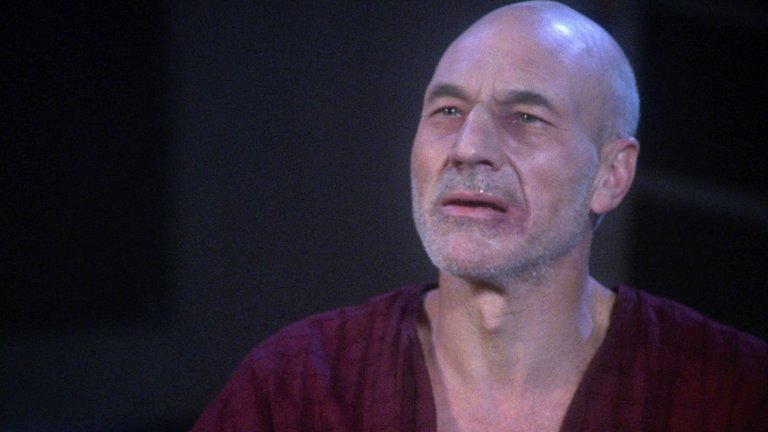
The episode's true centre of gravity, however, lies in a stark, oppressive Cardassian interrogation room. Here, Picard is subjected to a relentless and sophisticated torture regimen orchestrated by Gul Madred. The objective is not merely to punish but to extract strategic information regarding Starfleet's defensive plans for the Minos Korva sector. Picard truthfully insists he possesses no such knowledge, but Madred, a master of psychological warfare, proceeds undeterred. The physical degradation is immediate and humiliating: Picard is stripped naked, hung from the ceiling, and has a pain-inducing device surgically implanted in his chest. Madred, who pointedly allows his young daughter, Jil Orra (Helen Lauren Olson), to witness his work, employs a chilling array of psychological manipulations alongside the physical torment. His ultimate goal is to break Picard's perception of reality itself, famously demanding that the captain look at four glaring lights and confess to seeing five. Picard's repeated, defiant assertion—"There are four lights!"—becomes a mantra of resistance. Yet, the episode masterfully charts the erosion of that resolve; the physical agony and psychological isolation exact a terrible toll, making each denial feel increasingly fragile.
Aboard the Enterprise, a parallel strategic narrative unfolds with quiet ingenuity. Chief Engineer La Forge, examining the Cardassian delegation's ship, discovers microscopic traces of a rare particulate matter found only in the nearby McAllister C-5 Nebula. From this forensic clue, he deduces the presence of a hidden Cardassian invasion fleet. Jellico, demonstrating the tactical acumen that justifies his command, authorises a daring plan: using shuttlecraft, the Enterprise crew will covertly seed the nebula with antimatter mines, effectively trapping the Cardassian armada. The plan's success hinges on piloting skill of the highest order, forcing Jellico to swallow his considerable personal dislike and reinstate Riker for the mission. This narrative beat is crucial, transforming their conflict from petty squabbling into a professional respect forged under pressure. Riker executes the manoeuvre flawlessly, and the Cardassians, realising they are caught in a tactical checkmate, have no choice but to retreat and, as a bargaining chip, agree to Picard's release.
This liberation arrives at the most critical psychological moment. Madred is subjecting Picard to yet another session, demanding he acknowledge the fifth light. As Picard gathers his will for another refusal, he notices the arrival of guards. Realising his ordeal is over, he summons a final, magnificent defiance, snarling "There are four lights!" back at his tormentor. The victory is profound, but the episode refuses a simplistic triumphalism. In a deeply poignant scene back on the Enterprise—after Picard has resumed command from Jellico—he confides in Counsellor Troi. With raw, unvarnished honesty, he admits that had the torture continued, he would have been broken. He would have said he saw five lights. This admission of human fragility, from a character often portrayed as an unshakeable paragon, is the episode's most devastating and important moment.
Written by Frank Abatemarco and directed by series veteran Les Landau, Chain of Command, Part II is not an episode rich in visual pyrotechnics or action set-pieces. It compensates entirely through the sheer force of its drama. The torture sequences are intensely visceral, featuring an uncharacteristic level of nudity for 1990s network television (though strategically lit, Patrick Stewart was reportedly fully nude on the closed set). The depiction of sustained physical and psychological violence was so stark that the episode faced censorship in several international markets. Its power derives from a disturbing authenticity. Abatemarco and Stewart consulted extensively with Amnesty International, reviewing video testimonies and documentation to ground Madred's techniques in real-world interrogation practices. Furthermore, the literary shadow of George Orwell's 1984 is unmistakable, particularly the scene where O'Brien breaks Winston Smith by forcing him to betray his own sensory evidence about the number of fingers held up.
The episode also serves as vital piece of franchise world-building, providing seminal insight into Cardassian society. Madred, in a rare moment of ideological exposition, explains that his people were once enlightened pacifists, whose subsequent descent into poverty and scarcity made them embrace militarism and expansion as a means of survival. This nuanced motivation, painting the Cardassians as products of tragic history rather than cartoonish villains, provided a foundational template that Deep Space Nine—which premiered mere weeks after this episode—would explore in magnificent detail over its seven-season run.
Ultimately, the episode's greatest asset is the towering performance of David Warner. The esteemed English actor, who remarkably attended the same acting school class as Patrick Stewart yet had never before shared a screen with him, delivers a masterclass in subdued menace. Warner had previously appeared in two Star Trek films (The Final Frontier and The Undiscovered Country), but it is his portrayal of Gul Madred for which he is most remembered by Trekkies. He is neither a raving lunatic nor a sadistic monster; he is a chillingly rational, almost paternalistic figure, convinced of his cultural and personal superiority. His calm, methodical cruelty, juxtaposed with moments of apparent kindness towards his daughter, creates a villain of profound and unsettling complexity. His scenes with Stewart are nothing short of electrifying, a duel of acting titans that elevates the material into the realm of classic drama.
Chain of Command, Part II stands as a landmark not only for The Next Generation but for television sci-fi as a whole. It boldly replaces phaser battles and technobabble with an unflinching examination of torture, resilience, and the limits of the human spirit. By focusing on character and ideology, and by being anchored by two phenomenal performances, it achieves a depth and emotional resonance that few other episodes in the series can match.
RATING: 8/10 (+++)
Blog in Croatian https://draxblog.com
Blog in English https://draxreview.wordpress.com/
InLeo blog https://inleo.io/@drax.leo
LeoDex: https://leodex.io/?ref=drax
InLeo: https://inleo.io/signup?referral=drax.leo
Hiveonboard: https://hiveonboard.com?ref=drax
Rising Star game: https://www.risingstargame.com?referrer=drax
1Inch: https://1inch.exchange/#/r/0x83823d8CCB74F828148258BB4457642124b1328e
BTC donations: 1EWxiMiP6iiG9rger3NuUSd6HByaxQWafG
ETH donations: 0xB305F144323b99e6f8b1d66f5D7DE78B498C32A7
BCH donations: qpvxw0jax79lhmvlgcldkzpqanf03r9cjv8y6gtmk9