Rascals (S06E07)
Airdate: 2 November 1992
Written by: Allison Hock
Directed by: Adam Nimoy
Running Time: 46 minutes
Star Trek, to put it mildly, has never possessed the most sterling record when it comes to plots, characters, or storylines involving children. Even The Next Generation, the series generally considered the golden age of the franchise, often struggled with how to deal with young or juvenile characters, as evidenced by the frequently maligned Wesley Crusher or the awkwardly handled Alexander Rozhenko. Yet, the very epic, seven-year nature of the series allowed for occasional opportunities to get things right. In its penultimate season, that opportunity was finally—and rather bizarrely—taken with the episode titled Rascals. The result is a profoundly divisive piece of television that functions as either a delightful piece of fluff or an appallingly stupid nadir, depending entirely on the viewer's capacity for forgiving absurdity.
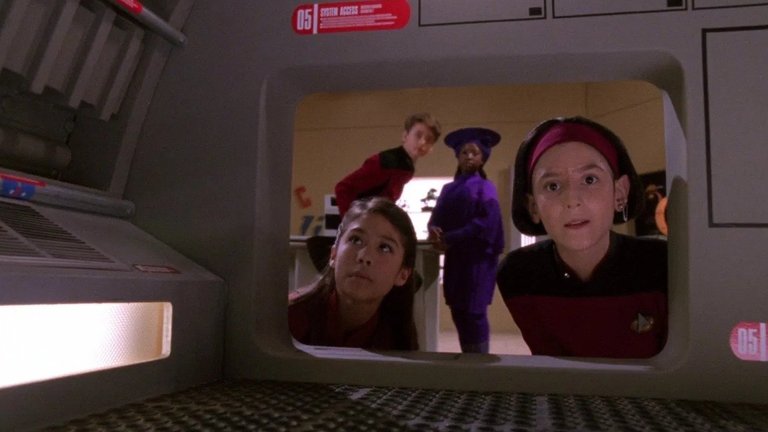
The plot begins conventionally enough. Captain Picard returns to the Enterprise with Ensign Ro Laren, Keiko O'Brien, and Guinan from a visit to the planet Marlonia, noted for its flora and rich history. Their shuttlecraft becomes caught in a strange energy anomaly, and the Enterprise is forced to execute an emergency beam-out. The crisis, however, is only beginning. When the quartet materialises in the transporter room, Chief Miles O'Brien is shocked to see not his captain and colleagues, but four bewildered twelve-year-old children. The transporter accident has physically de-aged them, though their memories and intellectual capabilities remain entirely intact. This premise establishes the episode's central, and rather high-concept, dilemma.
This new and frightening situation creates immediate practical and ethical problems for the crew. Picard, now portrayed by David Tristan Birkin, initially and predictably demands that he maintain command of the ship, but ultimately heeds Dr. Crusher's sensible suggestion to hand over temporary authority to Commander Riker. The characters' reactions to their predicament are varied and provide the episode's initial emotional core. Guinan, played by Isis Carmen Jones, is delighted with the opportunity to relive childhood, embracing the experience with whimsical wisdom. In stark contrast, the ever-intense Ro Laren, portrayed by Megan Parlen, is utterly terrified by the loss of her adult form and authority. The most acutely awkward scenario falls to Miles O'Brien, who must confront the surreal reality that his wife, Keiko, now inhabits the body of a twelve-year-old girl (Caroline Junko King). The poignant subplot where their young daughter, Molly, fails to recognise her mother adds a layer of genuine pathos that the script, to its credit, does not entirely gloss over.
Concurrently, Dr. Crusher theorises that, at worst, the four will simply grow up normally again, but she also begins working on experiments suggesting the de-aging can be reversed by applying a proper transporter buffer sequence. This scientific MacGuffin, however, is promptly sidelined. Two Klingon Birds-of-Prey suddenly decloak, attack the Enterprise, and damage its shields, allowing a boarding party to transport. The attackers are revealed to be Ferengi privateers led by the avaricious Lurin (Mike Gomez), who has obtained decommissioned warships for profit. They successfully take over the ship but cannot access the main computer. They also ignore the children on board. This oversight allows the de-aged Picard, Ro, Guinan, and Keiko, with the help of Alexander Rozhenko, to devise an audacious plan to defeat Lurin and his lieutenant, Berik (Tracey Walter).
The general concept for the episode originated in the show's fifth season. Although Allison Hock is the credited writer, the script was originally assigned to Ronald D. Moore, one of the franchise's most respected writers. Moore, by his own admission, considered the whole concept "nonsense" and did not want to do it. Despite his initial reluctance and despite scientific advisor Naren Shankar's failure to deliver a credible explanation for the biological and physical issues involved, Moore reportedly grew more enthusiastic by the end of the writing process, though he remained less than pleased with the final work. This behind-the-scenes struggle is palpable in the final product, which feels tonally disjointed, caught between wanting to explore its novel premise seriously and succumbing to the lure of outright farce.
The episode's execution benefits significantly from the directorial debut of Adam Nimoy, son of Leonard Nimoy, who brought experience from assisting Nicholas Meyer on Star Trek films. Nimoy's capable direction ensures a brisk pace and elicits remarkably convincing performances from the young cast, which is where Rascals finds its greatest success. The concept of de-aging was first utilised in Star Trek in the series finale of The Animated Series, The Counter-Clock Incident, but there it worked within a broader context of time and dimension reversal. Here, the concept is the actual bedrock of the plot, and the script ultimately embraces its inherent absurdity, treating the scenario primarily as an excuse for comedy. Consequently, we have the Ferengi—arguably the least threatening and most pathetic of all Star Trek villains—taking over the Federation's flagship in a farcical manner, only to be even more farcically defeated by a group of children.For a significant portion of the audience, however, this criticism is irrelevant; they enjoy the episode as a piece of whimsical fluff, a veritable guilty pleasure.
Much of the episode's ability to entertain hinges on its meticulous and inspired casting. David Tristan Birkin, who had previously played Picard's nephew in the episode Family, is exceptionally effective and credible as a young version of the captain, capturing Picard's stern demeanour and thoughtful hand gestures with uncanny accuracy. Isis Carmen Jones, whose prior notable credit was playing a young Whoopi Goldberg in Sister Act, is equally good as the young Guinan, conveying her enigmatic serenity.^ Megan Parlen is also highly convincing as the young Ro, expertly charting the character's journey from terror to determined resolve. These performances are crucial in selling the premise; they provide the human (or alien) anchor that makes the ridiculous plot somewhat palatable. The scene between Miles and the de-aged Keiko is a highlight precisely because of the authentic awkwardness it portrays.
Critically, however, Rascals fails to cohere into a satisfying whole. The episode suffers from a fundamental identity crisis. Its first act diligently sets up intriguing philosophical and personal questions about identity, authority, and the nature of ageing, only to abandon them completely in the third act for a simplistic action-comedy romp. The shift is jarring. The intriguing dilemma of how the crew interacts with a child-bodied Picard is quickly minimised, and the potentially fascinating social dynamics are traded for a Die Hard on a starship scenario that requires a monumental suspension of disbelief. The notion that the mighty Enterprise-D could be so easily captured by a handful of Ferengi in outdated Klingon vessels remains a persistent point of contention and mockery among fans.
In the end, Rascals is a textbook example of a "Broken Base" episode. It is either a harmless bit of nonsense with enough charm and clever performances to paper over its glaring plot holes, or it is a thoroughly idiotic idea that should never have made it past the writers' room. Its legacy is that of a curious oddity—an episode often ranked among the funniest of The Next Generation, yet simultaneously cited as one of its most implausible. It works best if viewed not as serious science fiction but as a broad, farcical comedy that temporarily transplants beloved characters into an utterly ridiculous situation. For every viewer who delights in young Picard running his hands through a full head of hair or in the coded father-son banter he uses with Riker to fool the Ferengi, there is another who cannot get past the sheer stupidity of the Ferengi's takeover scheme. Ultimately, Rascals is a flawed, frustrating, yet occasionally delightful experiment.
RATING: 7/10 (+++)
Blog in Croatian https://draxblog.com
Blog in English https://draxreview.wordpress.com/
InLeo blog https://inleo.io/@drax.leo
LeoDex: https://leodex.io/?ref=drax
InLeo: https://inleo.io/signup?referral=drax.leo
Hiveonboard: https://hiveonboard.com?ref=drax
Rising Star game: https://www.risingstargame.com?referrer=drax
1Inch: https://1inch.exchange/#/r/0x83823d8CCB74F828148258BB4457642124b1328e
BTC donations: 1EWxiMiP6iiG9rger3NuUSd6HByaxQWafG
ETH donations: 0xB305F144323b99e6f8b1d66f5D7DE78B498C32A7
BCH donations: qpvxw0jax79lhmvlgcldkzpqanf03r9cjv8y6gtmk9