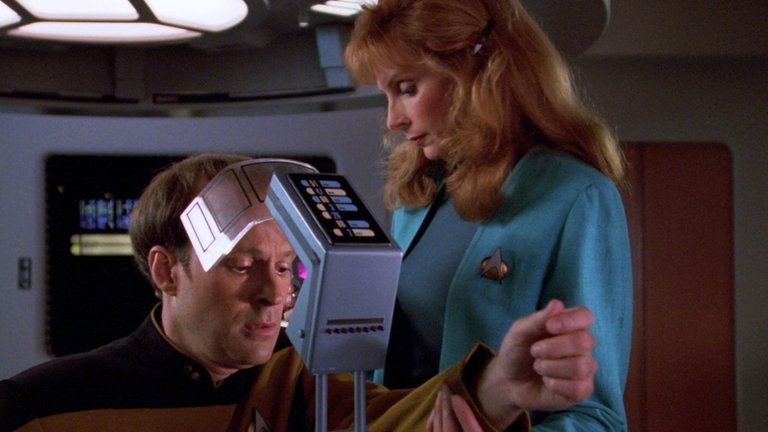
Realm of Fear (S06E02)
Airdate: 28 September 1992
Written by: Brannon Braga
Directed by: Cliff Bole
Running Time: 46 minutes
The enduring richness of Star Trek as a franchise often lies in its remarkable capacity to revisit established plot points, premises, and character types, reconfiguring them into fresh and compelling narratives. A prime, if understated, example of this alchemy can be found in Realm of Fear. This sixth-season episode, while neither particularly original nor ranked among the series’ most memorable outings, nonetheless functions as a solid and thoroughly entertaining piece of television. It succeeds by grafting a classic genre premise—the psychological horror of technology—onto one of the show’s most beloved and neurotic recurring characters, resulting in a story that is both a satisfying mystery and an effective character study.
The plot initiates with the USS Enterprise-D being dispatched to the Igo system to investigate the loss of contact with the USS Yosemite, a science vessel observing a plasma streamer. The Yosemite is located, but severe interference from the streamer renders transport hazardous. This technical difficulty catalyses the episode’s central drama: it acutely bothers Lieutenant Reginald Barclay, whose deep-seated transporter phobia surfaces, compelling him to refuse a beam-over. He is subsequently counselled by Deanna Troi, a scene which economically establishes the irrational yet visceral nature of his fear—a fear of dissolution and non-existence that many in the audience can intuitively understand, even in a 24th-century context.
Compelled by duty, Barclay finally overcomes his trepidation and transports to the derelict ship. The Yosemite is found empty save for the body of Lieutenant Joshua Kelly. It is during the return transport that the episode’s central weirdness unfolds: Barclay briefly glimpses a mysterious, worm-like creature that seems to reach for his arm. Thereafter, he is plagued by anxiety and the disturbing sight of his own left arm glowing with an ethereal light. Initially, he fears he is succumbing to the infamous and “incurable” transporter psychosis, a neat callback to franchise lore. His determination to prove his sanity, however, leads him to volunteer for another transport to the Yosemite, hoping to observe the phantom creatures again.
Upon his return, the mystery begins to unravel. Analysis reveals that Barclay’s arm is slightly out of phase, a phenomenon caused by microscopic organisms that bypassed the transporter’s biofilter. To purge them, Barclay is sent back into the transporter buffer to linger until the filters can work. In this liminal state, he again sees the creature and, in a moment of desperate courage, grabs it. This action has a miraculous consequence: when he is beamed back, a Yosemite crewman materialises with him. The Enterprise crew deduces the truth: the “wormlike creatures” are in fact the Yosemite crew, trapped in mid-transport by a disaster and rendered visible only to someone in a similar phased state. A rescue mission ensues. The episode concludes not with technobabble, but with a beautifully human moment between Barclay and Chief O’Brien, who has confessed his own fear of spiders and now produces his pet tarantula to help Barclay face his lingering anxiety—a moment of quiet solidarity and dark humour.
Realm of Fear was written by Brannon Braga, a legendary figure in Star Trek production. His premise cleverly repurposes a motif established in The Original Series era: the latent fear of the transporter, touching on deep anxieties about the nature of identity when a body is atomised and reconstituted. Braga has admitted to layering in his own real-life fear of flying, simply transposed onto this most iconic of Star Trek technologies. The narrative model is transparently the classic Twilight Zone episode “Nightmare at 20,000 Feet,” which famously starred William Shatner and was written by Richard Matheson, trading an aeroplane’s wing for a transporter pad.
Braga’s great move, however, was the deployment of Reginald Barclay. Already established as a popular, fascinating recurring character—the brilliant but deeply neurotic engineer—Barclay provides the perfect vessel for this story. Portrayed with immense skill and empathetic gusto by Dwight Schultz, Barclay delivers a performance that anchors the episode. He perfectly captures the torment of a man wrestling with a neurotic fear, painfully uncertain whether his visions are the product of a psychotic break or a terrifying reality. Schultz makes the audience feel every jolt of his anxiety.
Director Cliff Bole handles the material with great skill, maintaining a taut pace and leveraging the claustrophobic potential of the transporter room. Realm of Fear is historically notable as the first Star Trek episode to present a point-of-view shot from within the transporter beam itself, a subjective visual effect played to great unsettling effect.
Where the episode arguably falters is in its final exposition. The scientific resolution to the mystery of the worm-creatures feels somewhat rushed and buried under a heap of technobabble. The explanation—microbes causing a phase variance—serves more as a convenient plot mechanism to enable Barclay’s character arc than as a naturally unfolding puzzle. It is a functional, rather than elegant, piece of Star Trek problem-solving.
Nevertheless, the episode’s strengths significantly outweigh this flaw. It delivers an effective dose of mystery and body horror (the glowing arm is a particularly unsettling image) leavened with dark humour. It offers not only a superb performance from Dwight Schultz but also delightful interplay with Colm Meaney’s grounded and pragmatic Chief O’Brien. Their final scene transcends the technobabble, returning the story to its core: the universal struggle with fear, and the courage found in confronting it, even with a giant spider in the room. In this, Realm of Fear achieves what the best of Star Trek often does: using a speculative fiction premise to explore a profoundly human truth.
.
RATING: 6/10 (++)
Blog in Croatian https://draxblog.com
Blog in English https://draxreview.wordpress.com/
InLeo blog https://inleo.io/@drax.leo
LeoDex: https://leodex.io/?ref=drax
InLeo: https://inleo.io/signup?referral=drax.leo
Hiveonboard: https://hiveonboard.com?ref=drax
Rising Star game: https://www.risingstargame.com?referrer=drax
1Inch: https://1inch.exchange/#/r/0x83823d8CCB74F828148258BB4457642124b1328e
BTC donations: 1EWxiMiP6iiG9rger3NuUSd6HByaxQWafG
ETH donations: 0xB305F144323b99e6f8b1d66f5D7DE78B498C32A7
BCH donations: qpvxw0jax79lhmvlgcldkzpqanf03r9cjv8y6gtmk9