The Laws of Gods and Men (S4x06)
Airdate: 11 May 2014
Written by: Bryan Cogman
Directed by: Alik Sakharov
Running Time: 50 minutes
Game of Thrones stands as the best-known and arguably the most popular fantasy series in the history of television, but throughout its run, it has consistently toyed with other, more generic genres – from action and adventure to horror, romance, and, as HBO’s mandate often ensured, erotic thriller. In its fourth season, the series added another genre to its repertoire with The Laws of Gods and Men, which deftly incorporates the mechanics of a courtroom drama into its medieval political tapestry. In doing so, the episode delivers one of the most emotionally devastating and memorable moments of the entire series, a climax that would come to define the season. This structural gambit, written by Bryan Cogman – the semi-official keeper of the series ‘bible’ – maintains the show’s signature format of interweaving disparate storylines across its vast geography. What makes this instalment particularly interesting is that, for the first time, two of these storylines are set in the eastern continent of Essos, expanding the show’s scope while testing its narrative cohesion.
The first of these Essosi threads is set in Meereen, where Daenerys Targaryen, having conquered the city, sits in the Grand Pyramid to hear supplicants. This sequence serves as a pointed depictions of the burdens of rule, ranging from a goatherd demanding compensation for his flock, torched by one of Daenerys’s growing dragons, to the more nuanced plea from Hizdahr zo Loraq (Joel Fry). Hizdahr, the son of a former slave master crucified by Daenerys’s order as retribution for the previous crucifixion of slaves, claims his father opposed that brutality and asks for his body to be given a proper burial. Daenerys’s reluctant agreement here is a small but significant moment, highlighting her struggle to transition from liberator to governor, a theme that would come to dominate her arc. The scene is bookended by impressive visual effects, as the episode’s budget is flaunted in a striking shot of a large dragon immolating goats – a spectacle that, while thrilling, underscores the unintended consequences of her power.
The second Essos storyline takes place in Braavos, where Stannis Baratheon, accompanied by his loyal Hand Davos Seaworth, arrives to personally plead for a loan from the Iron Bank. The representative, Tycho Nestoris (Mark Gatiss), is initially dismissive, noting Stannis’s lack of men and resources to continue his war. It is Davos, with his characteristic blunt honesty, who salvages the situation. He successfully argues that the Bank putting all its support behind the Lannisters is a risky investment, given Tywin’s advanced age and the instability likely to follow his death. This subplot is elevated by another lavish CGI set-piece: Stannis’s ship entering Braavos harbour by sailing beneath the monumental statue of the Titan, a direct homage to the Colossus of Rhodes that visually reinforces the city’s grandeur and the show’s production ambitions.
Back in Westeros, the episode delivers its most contentious original addition: Yara Greyjoy’s raid on the Dreadfort. With a small band of Ironborn, she manages, against all odds, to penetrate Ramsay Bolton’s stronghold in a bid to free her brother, Theon. The scene’s primary function is to illustrate, in the clearest possible terms, how profoundly broken Theon has become. When Yara finds him, he is so mentally shattered and convinced her rescue is another of Ramsay’s cruel tricks that he calls himself ‘Reek’ and refuses to leave. Forced to retreat as Ramsay arrives, Yara later tells her men that Theon is ‘dead’. The sequence is undeniably melodramatic and serves as convenient fan service, providing the requisite sex scene with Ramsay and Myranda, and later showcasing a shirtless Ramsay dispatching two fully armoured Ironborn – a moment that stretches plausibility and highlights the scene’s logistical weaknesses. The idea of a single Ironborn ship travelling across the world for a mission that fails at the last minute feels more like a contrived plot device than organic storytelling, a rare misstep in an otherwise tightly constructed episode.
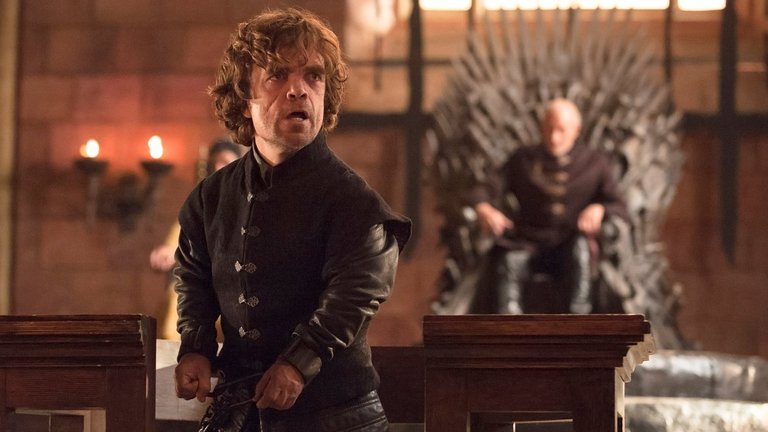
Of course, the episode’s centrepiece and undeniable triumph is the trial of Tyrion Lannister in King’s Landing. From the outset, it is a show trial with a preordained outcome, a parade of witnesses – including a devastating turn by Shae – testifying against him. Knowing his brother will be found guilty and executed, Jaime brokers a desperate deal with Tywin: he will leave the Kingsguard and assume his role as heir to Casterly Rock, in exchange for Tyrion’s life being spared and him being sent to the Night’s Watch. Tyrion, deeply sceptical and acutely aware of how similar arrangements ended for Ned Stark, is cornered. The trial scene, however, transforms from a judicial farce into a searing character study. When Shae takes the stand and betrays him, Tyrion’s last romantic illusion is brutally shattered. Consumed by a lifetime of bitterness and this final, most hurtful personal betrayal, he unleashes a defiant, volcanic tirade against his accusers, culminating in his demand for a trial by combat.
This sequence is exceptional television. Although it ends on a melodramatic cliffhanger to be resolved later, it features a devastating twist that, in light of the series’ darkly cynical depiction of the human condition, feels utterly believable. It also feature brilliant acting performance by Peter Dinklage. Playing a character stripped of all his defences and faced with ultimate betrayal, Dinklage delivers what is arguably one of the strongest performances in the entire series. His monologue is a raw, cathartic release of years of pent-up resentment, and it elevates the episode from great to unforgettable. Critics universally acclaimed this scene, with many highlighting Dinklage’s performance as the highlight.
The Laws of Gods and Men is a fascinating hybrid. It showcases the series’ ambition and budget with its impressive set-pieces in Essos, and it delivers a landmark character moment in King’s Landing that remains a high-water mark for the show. However, it is not without its flaws. The Dreadfort rescue subplot, while effective in illustrating Theon’s degradation, feels like a contrived, non-canonical addition that prioritises melodrama and fan service over narrative plausibility. Yet, these shortcomings are ultimately overshadowed by the sheer power of its concluding act. By successfully grafting a courtroom drama onto its fantasy foundation, the episode proves that Game of Thrones was at its best when leveraging genre conventions to deepen its character portraits, resulting in a chapter that is both structurally innovative and emotionally ruinous.
RATING: 7/10 (+++)
==
Blog in Croatian https://draxblog.com
Blog in English https://draxreview.wordpress.com/
InLeo blog https://inleo.io/@drax.leo
LeoDex: https://leodex.io/?ref=drax
InLeo: https://inleo.io/signup?referral=drax.leo
Hiveonboard: https://hiveonboard.com?ref=drax
Rising Star game: https://www.risingstargame.com?referrer=drax
1Inch: https://1inch.exchange/#/r/0x83823d8CCB74F828148258BB4457642124b1328e
BTC donations: 1EWxiMiP6iiG9rger3NuUSd6HByaxQWafG
ETH donations: 0xB305F144323b99e6f8b1d66f5D7DE78B498C32A7
BCH donations: qpvxw0jax79lhmvlgcldkzpqanf03r9cjv8y6gtmk9