In my previous post about the Japanese Iroha Karuta I looked at the proverb the Angel™ deck uses for the twentieth syllable in the "iroha" sequence, which is "ne" (ね): 念には念を入れよ (nen ni wa nen o ireyo), adding care to care.
https://peakd.com/alive/@hirohurl/iroha-karuta-20a-the-japanese-virtue-of-double-checking-everything
The cheap Daiso deck takes a completely different direction for the same character. Its choice for ね is:
猫に小判
(Neko ni koban)
Literally: "A koban to a cat."
What on earth is a "koban"?
A koban (小判) was an oval gold coin that was first minted in 1601 as part of the Tokugawa coinage, and which continued to be minted in various forms until the end of the Edo era.
Koban were minted mainly for foreign trade since the Portuguese and other foreign traders didn't really want to be paid in the good old currency - rice.
Rice itself was measured in "koku" and one koku was the amount of rice sufficient for one person for one year. The first koban were minted to the value of three koku, which presumably made life easier for the Japanese merchant in his negotiations with Portuguese and then Dutch traders.
What is a Koban to a Cat or a Cat to a Koban?
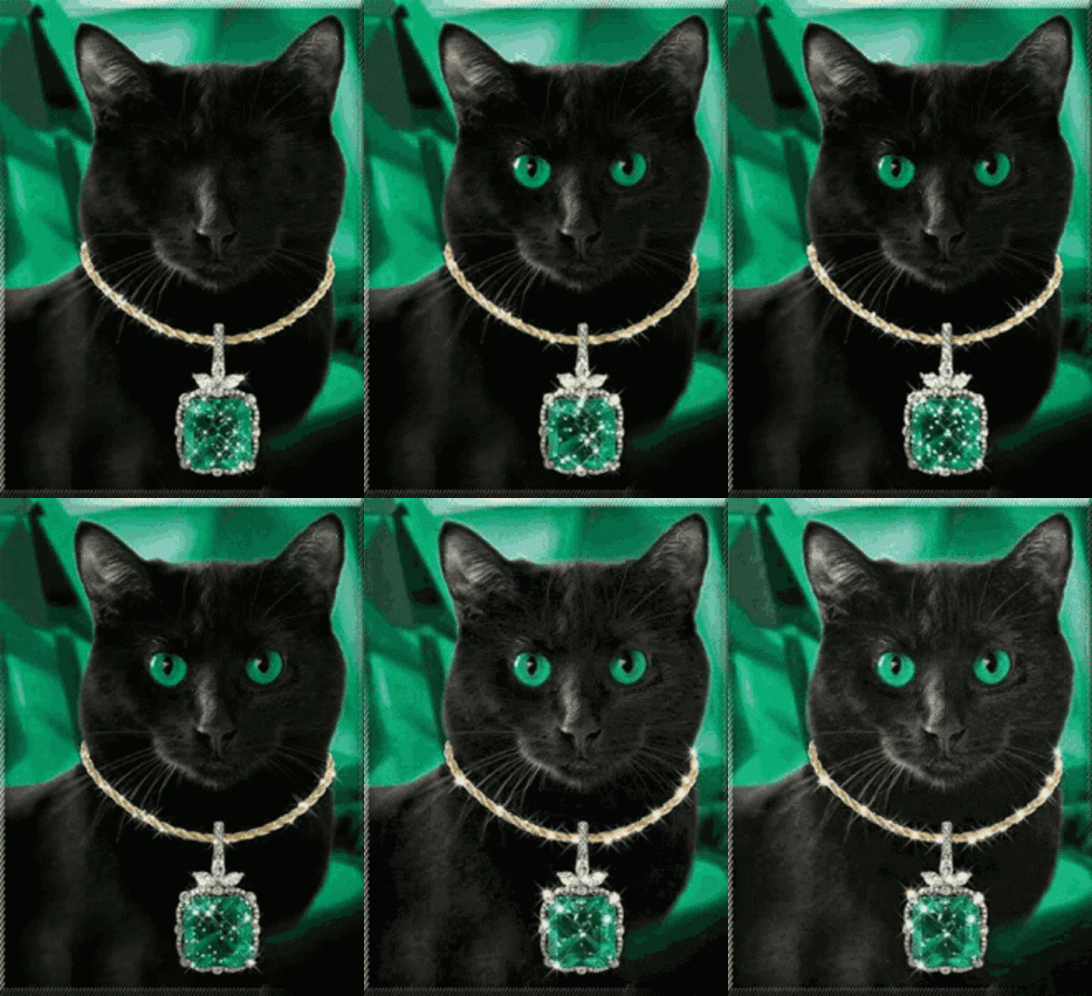
No matter what the value of a koban may be for your Japanese merchant or foreign trader, a cat native or foreign, has no use for it. You could place a koban, be it never so valuable, in front of a cat and it would ignore it, or pretend to ignore it, then bat it around and lose it under the furniture, then wander off as if nothing had happened.
In short, the proverb means: giving something of value to someone who can neither appreciate nor use it is pointless.
In English, the closest equivalent can also be uttered in three words,
"Pearls before swine,"
which is shorthand for the injunction from the Sermon on the Mount in the seventh chapter of the Gospel According to Matthew:
Give not that which is holy unto the dogs, neither cast ye your pearls before swine, lest they trample them under their feet, and turn again and rend you.
Matthew 7:6
Giving holy things to dogs is also a bit like giving precious things to cats. However, those biblical dogs and swine are charged with rather more pejorative freight than a Japanese cat. They are unclean, unworthy, even dangerous, since the verse warns the swine may charge at you and gore you for your efforts, just as a wild boar gored Venus' toy-boy, Adonis.
The Japanese proverb carries none of that pejorative charge. The cat is not being condemned. It is not unclean or unworthy. It simply has no use for gold. The proverb questions the judgement of the giver, not the character of the recipient. A cat is just a cat. You cannot blame it for being indifferent to money.
Okay, back to the Japanese proverb:
猫に小判
Neko ni koban.
猫 (neko) = cat
に (ni) = to, for (indicating the recipient)
小判 (koban) = a gold coin
The grammar is minimal: just a noun, a particle, and another noun. There is no verb. The proverb works entirely through the absurdity of the image. A cat and a gold coin. What would a cat do with it?
That compression is part of what makes this and many other kotowaza memorable and effective as teaching tools. You aren't merely learning the syllable "ne" ね but also a concept about value, context, and the futility of mismatched giving.
The Daiso Illustration
These cheap Daiso cards really are great value for money! While I wouldn't say they are quite worth a koban, I have nevertheless extracted far more value from this el-cheapo karuta deck than the measly 110 yen I was charged for it. The illustrations are fun and to the point, and the illustration twentieth syllable is no exception.
We see a cat looking in bewilderment at a diamond ring in front of him, with a question mark over his head, as if he's wondering,
"WTF is this?"
Meanwhile, the diamond is glistering, ピカッ ピカッ "pika! pika! - the Japanese equivalent of "twinkle twinkle."
The artist has replaced the "koban" with a more immediately relatable equivalent - everybody knows what a diamond ring is and how valuable it is.
Koban (小判) — The Gold Coin and Its Debasement
The koban's history is a story of steady debasement. Some feudal lords began minting their own koban, but with alloys which reduced the pure gold content.
Periodical government reforms of the coin debased it even further so that older counterfeit coins, minted when the gold content was higher, were in practice worth more than a new legitimate coin so, by the time Commodore Matthew Perry arrived with his black ships in 1853, merchants tended to prefer old forgeries to later government minted koban.

Today, gold-foil cardboard versions of koban are sold as "engimono" (縁起物) talismans or lucky charms at Shinto shrines, but I doubt that any foreign traders would want to receive them in exchange for their wares.
The Cat That Beckons Gold
The proverb tells us that gold is wasted on a cat. But Japanese culture also holds the opposite idea: that a cat, in the right situation and posture, brings gold to you.
The maneki-neko (招き猫), literally "beckoning cat," is a common Japanese figurine supposed to bring good luck to its owner. The cat has one paw raised in a beckoning gesture, and is traditionally shown seated and holding a koban.
I wonder if the proverb was inspired by the maneki neko, or the maneki neko holding a koban was inspired by the proverb. Perhaps it is merely a coincidence.
Either way, Maneki-neko are found near the entrances of shops, restaurants, pachinko parlors, hotels, and many other businesses as well as homes. The raised paw is not a wave but a Japanese beckoning gesture. If the left paw is raised, it is said to attract customers. If the right paw is raised, it is said to attract money. If both paws are raised, I guess the cat is surrendering.

Chatgpt versus Google Translate
Once again, this was really no contest. Here's the challenge I set Chatgpt:

Okay, you can see that I had asked it to create an image, so it already had some context, whereas with Google Translate I simply pasted in the Japanese and hoped for the best. It was a forlorn hope:

There is no case in Japanese as far as I know in which "koban" refers to "small size" alone.
Speaking of which, the "ban" in "koban" can also be pronounced "han" and means something like a governmental seal or official stamp. As such, it is the first kanji in the word "hanko" (判子), which is your personal seal, an essential bit of "everyday carry" kit when you live in Japan as it is used to stamp documents or receipts and sometimes class attendance registers and so forth and is used instead instead of a signature.
But we are drifting off topic, so let's wrap this up...
Neko ni koban - 猫に小判 - is one of the more commonly known kotowaza among Japanese speakers today. If you ask someone for an example of a Japanese proverb, there is a reasonable chance this one comes up. In that sense, the Daiso deck designer chose a popular saying, one the meaning of which can be instantly grasped whatever you think of cats and their relationship to gold.
Cheers!
Sources
Koban: https://en.wikipedia.org/wiki/Koban_(coin)
Maneki Neko: https://en.wikipedia.org/wiki/Maneki-neko
Maneki Neko image: https://books.google.co.jp/books?id=qdVGCgAAQBAJ&pg=PA30&source=gbs_toc_r&cad=2#v=onepage&q&f=false